In my writing, I’ve been known to share the good, the bad, and the ugly of my life at times. I do this in hopes of encouraging others to seek their answers where I found mine, in the knowledge of Scripture. This knowledge helps us realize that if we follow Jesus according to His will, not ours, we will come to experience peace far beyond our own understanding. Our lives have many Satan-crafted pitfalls designed to inch us away from our Creator and towards a valley of eternal death.
As a young man, I was baptized into Christ for the forgiveness of my sins and lived faithfully for many years. Faithfulness does not mean being without sin; rather, it means making every effort to pursue righteousness by following Jesus’ teachings and keeping His commandments. Sometimes we fail; however, if we know Scripture, it helps us recognize our failures, return to our creator, repent of our sins, and ask for forgiveness. Since we know from scripture that baptized believers are in Christ, God will forgive us when we repent.
The crux of God’s forgiveness is our repentance.
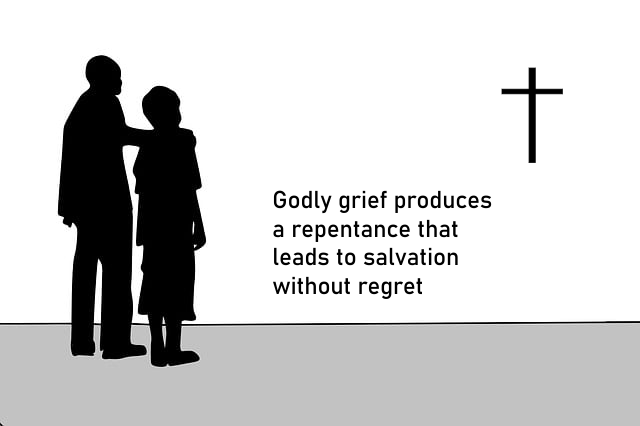
To truly repent of sin is to turn away from those sins as we experience Godly Sorrow, dedicating ourselves from that point to the correction of our lives using the Word of God as our foundation. Scripture defines Godly Sorrow this way: “For Godly grief produces a repentance that leads to salvation without regret, whereas worldly grief produces death.” (2 Corinthians 7:10).
With Godly grief, we repent of sinful ways; this means we change direction and stop indulging in those temptations that go against God’s Holy Word. Scripture lets us know that baptized believers who choose to indulge and continue doing what we know to be wrong are crucifying Christ once again.
“For if, after they have escaped the defilements of the world by the knowledge of the Lord and Savior Jesus Christ, they are again entangled in them and are overcome, the last state has become worse for them than the first. For it would be better for them not to have known the way of righteousness, than having known it, to turn away from the holy commandment handed on to them.” 2 Peter 2:20-21
also see: Hebrews 6:4-6, James 5:19-20, Hebrews 10:26-27
Although a baptized believer, I ended up spending 20 years with my soul in a lost condition as I had succumbed to a series of temptations and pitfalls designed by Satan.
I thought my faith was strong, but my decisions after a failed marriage proved my knowledge was weak, and my commitment shaken. I allowed myself, inch by inch, to pursue worldly desires over following Jesus. These infractions stacked and built to the point that during those 20 years, I feared correction could jeopardize my adopted lifestyle and possibly put my relationship at risk.
I was, however, acutely aware that my choices had me living in sin. This bothered me. Satan had successfully painted me into a corner, forcing me to choose between following Jesus according to His will or losing my soul.
Indeed, as scripture states, I was crucifying Christ to myself. Years I can’t get back, a bad example to family and friends that can’t be unset, where soul-risking damage was done. Today, I draw on those years as fuel for my efforts to never give up on encouraging others to grow in Christ, and I often pray that, if they won’t listen to me, God will put people in their lives they might. I cannot imagine ever allowing Satan to turn me away from God again.
I pray that if you’re reading this and reflecting on your own life, you find yourself right with God; but if not, I pray you will experience godly grief that produces repentance that leads to salvation without regret, rather than worldly grief that produces death.
God First, forever and ever, Amen!
If you’re not yet in Christ as a baptized believer:
- God’s Grace: Ephesians 2:8, Romans 3:24, Titus 2:11, Acts 15:11
- Hearing the Gospel:– Romans 10:17, John 8:32
- Belief/Faith: – Hebrews 11:1, John 8:24, Romans 10:17, Acts 3:19
- Repentance of sin: – 2 Cor. 7:9-10, Luke 13:3-5, Acts 17:30
- Confess Christ: – Romans 10:9-10, Matthew 10:32-33, Luke 12:8-9
- Baptism by immersion for forgiveness of sin: – Matthew 16:15-16, 1 Peter 3:21, Acts 2:38, Mark 16:16, John 3:5, Matthew 28:18-20, Ephesians 4:5, Romans 6:3-4, Colossians 2:12, Acts 8:36-39, Mark 1:9-10, John 3:23


Recent Comments