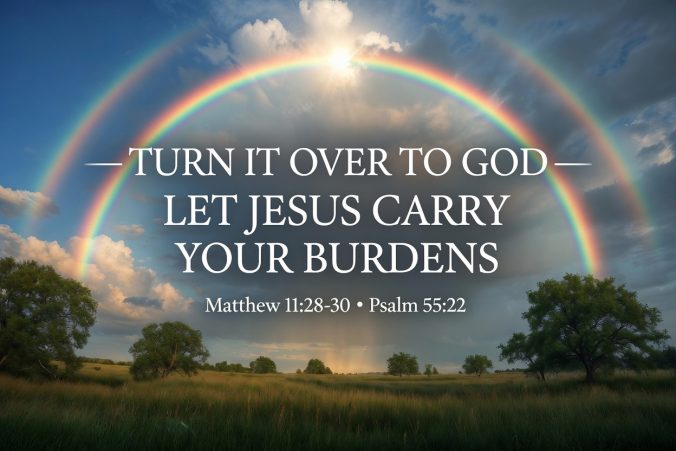
The best life is a God First life

Tag: Trust God

Worry changes nothing!

And which of you by being anxious can add a single hour to his span of life?” (Matthew 6:27, ESV) While we need to prepare and be as prepared as possible, it does us “no good” to worry. WORRY CHANGES NOTHING (and it may harm our health). Worry cannot add an hour to life. The Father’s care, not our anxiety, sustains us. With or without worry, we still have to meet each day’s trouble on that day. “Therefore do not be anxious about tomorrow, for tomorrow will be anxious for itself. Sufficient for the day is its own trouble.” (Matthew 6:34, ESV)

While this seems easier said than done, God is able to guard what we cannot control. The key is to be “in Christ” and allow the God of all comfort to be with us in every trial. Pray without ceasing.

“Do not be anxious about anything, but in everything by prayer and supplication with thanksgiving let your requests be made known to God. And the peace of God, which surpasses all understanding, will guard your hearts and your minds in Christ Jesus.” (Philippians 4:6–7, ESV)

“Humble yourselves, therefore, under the mighty hand of God so that at the proper time he may exalt you, casting all your anxieties on him, because he cares for you.” (1 Peter 5:7, with 5:6)

“Rejoice always, pray without ceasing, give thanks in all circumstances; for this is the will of God in Christ Jesus for you.” (1 Thessalonians 5:16–18)

Blessed be “the Father of mercies and God of all comfort, who comforts us in all our affliction.” (2 Corinthians 1:3–4, ESV)

Jesus’ answer is not merely “stop worrying.” It is to put God first:

“But seek first the kingdom of God and his righteousness, and all these things will be added to you.” (Matthew 6:33)

The peace that surpasses understanding is promised to those who are in Christ Jesus. Peace is God’s gift, not something we manufacture.

The following Scripture tells us how we become “in Christ.

“Do you not know that all of us who have been baptized into Christ Jesus were baptized into His death? We were buried therefore with Him by baptism into death, in order that, just as Christ was raised from the dead by the Glory of the Father, we too might walk in newness of life. For if we have been united with Him in a death like His, we shall certainly be united with Him in a resurrection like His. We know that our old self was crucified with Him in order that the body of sin might be brought to nothing, so that we would no longer be enslaved to sin. For one who has died has been set free from sin. Now if we have died with Christ, we believe that we will also live with Him. We know that Christ, being raised from the dead, will never die again; death no longer has dominion over Him. For the death He died He died to sin, once for all, but the life He lives He lives to God. So you also must consider yourselves dead to sin and alive to God in Christ Jesus.” (Romans 6:3–11) We are saved by grace through faith, we can’t earn God’s peace.

The gospel does call us to respond:

Hear the Gospel: Romans 10:17; John 8:32
Belief/Faith: Hebrews 11:1; John 8:24; Romans 10:17
Repentance: 2 Corinthians 7:9–10; Luke 13:3–5; Acts 17:30; Acts 3:19
Confess: Romans 10:9–10; Matthew 10:32–33; Luke 12:8–9
Baptism by immersion for the forgiveness of sins: 1 Peter 3:21; Acts 2:38; John 3:5; Matthew 28:18–20; Ephesians 4:5; Romans 6:3–4; Colossians 2:12; Acts 8:36–39; Mark 1:9–10; John 3:23

Additional references: Matthew 6:25–34; Luke 12:22–32; Philippians 4:4–7; Isaiah 26:3; Psalm 55:22; Psalm 56:3–4; Psalm 94:19; Proverbs 3:5–6; Proverbs 12:25; John 14:27; John 16:33; Colossians 3:15; Hebrews 13:5–6; 2 Timothy 1:7; Romans 8:31–32; Ephesians 2:8–9.

God First!

Forgive the Repentant. Release the Rest to Jesus

If someone wrongs me and repents, I will forgive them. If they do not repent, I will not let bitterness rule my heart. I turn the matter over to Jesus, and as the song says, “let it go.” That does not mean the sin was small. It does not mean there are no consequences. It means I refuse to become the judge, the avenger, or the prisoner of someone else’s evil. If a person truly has a repentant heart, they will want to admit the wrong, accept the consequences of their actions, and resolve not to repeat them. Repentance is not a quick “I’m sorry” designed to escape accountability. Godly sorrow produces a change of mind that leads to a change of life. Even then, we must remember this: repentance and forgiveness do not erase consequences. Our actions still have consequences.

I recently heard the father of a young man who had been murdered speaking on the news. He spoke of forgiving his son’s killer and of his determination not to become bitter. He was right about bitterness. Bitterness does not heal a wound. It deepens it. It does not bring justice. It only adds a second injury to the first. God is our best example of how to handle forgiveness. To be forgiven by God, a person must change direction—repent—and seek His mercy on His terms. God does not pronounce the impenitent forgiven. The father in that news report said the murderer had not asked for forgiveness. That matters. We can refuse hatred without pretending God has already cleared an unrepentant sinner. Jesus made the same distinction when He taught His disciples how to treat a brother who sins:

“Pay attention to yourselves! If your brother sins, rebuke him, and if he repents, forgive him, and if he sins against you seven times in the day, and turns to you seven times, saying, ‘I repent,’ you must forgive him.” (Luke 17:3–4 ESV)

Notice the order: rebuke, repentance, then forgiveness. We are not told to ignore sin. We are not told to restore a relationship as if nothing happened when there is no repentance. We are told that when repentance comes—even repeatedly—we must forgive.That is how God treats us. Peter preached:

“And Peter said to them, ‘Repent and be baptized every one of you in the name of Jesus Christ for the forgiveness of your sins, and you will receive the gift of the Holy Spirit.’” (Acts 2:38 ESV)

And again:

“Repent therefore, and turn back, that your sins may be blotted out.” (Acts 3:19 ESV)

“If we confess our sins, he is faithful and just to forgive us our sins and to cleanse us from all unrighteousness.” (1 John 1:9 ESV)

“Whoever conceals his transgressions will not prosper, but he who confesses and forsakes them will obtain mercy.” (Proverbs 28:13 ESV)

True repentance is more than regret that one got caught. Scripture says:

“For godly grief produces a repentance that leads to salvation without regret, whereas worldly grief produces death.” (2 Corinthians 7:10 ESV)

John the Baptist put it even more plainly: “Bear fruit in keeping with repentance” (Matthew 3:8 ESV). A repentant person does not demand to keep the sin and receive the pardon too. Yet forgiveness is not the cancellation of every earthly result.

David was forgiven, but consequences still followed. Moses still did not enter Canaan. A forgiven thief may still owe restitution. A forgiven offender may still face prison, broken trust, lost relationships, or a lifetime of repair. God is merciful. He is also just. Pardon restores us to God; it does not rewrite every wrong we have done.

What, then, do we do when the offender never asks, never admits, never turns? We do not avenge ourselves. We do not feed bitterness. We do not let another person’s wickedness become the master of our soul.

Some people say, “I forgive them,” meaning, “I will not spend the rest of my life hating that person or letting what they did destroy my heart.” I understand that language. I call it turning the case over to Jesus, letting it go, and trusting God’s Word. If justice is not fully met on earth, it will be met before the throne of Christ. That is not the same as saying God has already forgiven an unrepentant person. It is saying we will not carry a burden God never assigned to us. Scripture commands us to put bitterness away:

“Let all bitterness and wrath and anger and clamor and slander be put away from you, along with all malice. Be kind to one another, tenderhearted, forgiving one another, as God in Christ forgave you.” (Ephesians 4:31–32 ESV)

“bearing with one another and, if one has a complaint against another, forgiving each other; as the Lord has forgiven you, so you also must forgive.” (Colossians 3:13 ESV)

And when we pray, Jesus says we must not clutch a grudge:

“And whenever you stand praying, forgive, if you have anything against anyone, so that your Father also who is in heaven may forgive you your trespasses.” (Mark 11:25 ESV)

“For if you forgive others their trespasses, your heavenly Father will also forgive you, but if you do not forgive others their trespasses, neither will your Father forgive your trespasses.” (Matthew 6:14–15 ESV)

Those verses do not teach cheap grace. They teach that a hard, vengeful, unforgiving spirit is incompatible with people who have themselves been shown mercy. God forgave us in Christ when we repented and obeyed the gospel. We are to have that same readiness: eager to forgive the repentant, unwilling to become bitter toward the unrepentant, and careful not to seize God’s seat as Judge. We can also pray for those who have wronged us, as Jesus and Stephen did:

“And Jesus said, ‘Father, forgive them, for they know not what they do.’” (Luke 23:34 ESV)

“And falling to his knees he cried out with a loud voice, ‘Lord, do not hold this sin against them.’” (Acts 7:60 ESV)

That prayer is not a declaration that the guilty are already cleared. It is an appeal that God would bring them to repentance and mercy. We can ask God not to let their sin destroy us, and we can ask Him to deal with them in truth. Meanwhile, we cast the weight on the Lord:

“casting all your anxieties on him, because he cares for you.” (1 Peter 5:7 ESV)

“Come to me, all who labor and are heavy laden, and I will give you rest. Take my yoke upon you, and learn from me, for I am gentle and lowly in heart, and you will find rest for your souls. For my yoke is easy, and my burden is light.” (Matthew 11:28–30 ESV)

And we leave justice with Him:

“Beloved, never avenge yourselves, but leave it to the wrath of God, for it is written, ‘Vengeance is mine, I will repay, says the Lord.’ To the contrary, ‘if your enemy is hungry, feed him; if he is thirsty, give him something to drink; for by so doing you will heap burning coals on his head.’ Do not be overcome by evil, but overcome evil with good.” (Romans 12:19–21 ESV)

“then the Lord knows how to rescue the godly from trials, and to keep the unrighteous under punishment until the day of judgment.” (2 Peter 2:9 ESV)

Jesus is Judge. We may never see the full accounting in this life. We do not need to. His Word is enough. So the Christian path is not bitterness, and it is not pretend innocence. It is this:

  • Rebuke sin when we must.
  • Forgive the one who truly repents—again and again.
  • Remember that forgiveness does not abolish consequences.
  • Refuse to hate the one who will not repent.
  • Pray for their repentance.
  • Place the case in the hands of Christ.
  • Overcome evil with good.

That is not weakness. That is faith. We love as Christ loved (John 13:34). We tell the truth about repentance. We trust the Judge who never misses a case.

Luke 17:3–4; Mark 11:25; Matthew 6:14–15; Matthew 18:21–35; Ephesians 4:31–32; Colossians 3:13; Acts 2:38; Acts 3:19; Acts 7:60; Luke 23:34; 1 John 1:9; Proverbs 28:13; 2 Corinthians 7:10; Matthew 3:8; Romans 12:17–21; Matthew 11:28–30; 1 Peter 5:7; 2 Peter 2:9; John 13:34; Hebrews 10:30

God First

Finding God’s Comfort on Painful Anniversaries

Some dates, like birthdays, bring us happiness and Joy, while some dates bring heart-wrenching memories of shattered hearts, terrible life-changing events, death, and accidents. I often pray for the emotional strength and comfort that only God can provide for all my loved ones during these times. I once prayed, ”Father, please help all my family and us in these coming days, as I don’t know what to do.” As I said, “I don’t know what to do.” It dawned on me—I was doing it! Nothing is more powerful than God’s help; God can comfort our hearts and minds beyond understanding and place people in our lives who help us overcome despair. His approach may not be simply the love and compassion of good friends, but rather God may be helping by providing us opportunities to help others in need; opportunities that, if we pursue them, focus our minds and time on others, which distract us from the temptation to wallow in sorrow. Look for opportunities to do good; these are blessings to the heart. (Galatians 6:9-10)

Praying is so simple that we might diminish its value and forget just how powerful communicating with our Creator truly is. Scripture tells us: “The prayer of a righteous person has great power as it is working.” So, pursue righteousness with all we have to give.

Scripture also states: “Draw near to God, and He will draw near to you. Cleanse your hands, you sinners, and purify your hearts, you double-minded.” James 4:8 So, Let’s pursue righteousness and pray often with righteous prayers from loving hearts, then trust God!

Galatians 6:9-10; James 5:16; James 4:8; Mark 11:24; Zechariah 1:3; Philippians 4:6-7; John 15:7; 2 Corinthians 1:3-4; Psalm 34:18; 1 Peter 5:7; Hebrews 4:16; 1 John 5:14-15; Matthew 5:4; Psalm 147:3.

God First!

We Control Nothing — God Controls Everything

Dear Christians, there are times when we feel overwhelmed with concern for others or ourselves, when nothing seems within our control. Have you remembered to pray? Are you drawing closer to God (James 4:8), pleading, begging, and relentlessly asking our Heavenly Father for help? We need to go to Him in Fervent Prayer, and most of all, be willing to “Turn It Over

These are such simple words, but for some reason they seem to be so hard to do, at least until we realize we control nothing and God controls everything.

We must understand that when we are no longer in this world, God still answers prayers within it. Trust in God and let Jesus carry the burden. It’s foolish not to rely on the greatest power we have as Christians. God is the God of all comfort, so let Jesus carry your burdens and lift the weights from our shoulders; don’t try carrying them alone. This does not mean we stop doing our part; it does mean we should not worry but rather trust. Could it be a test? If so, let’s do well and show our trust. (1 Peter 1:6–7, 1 Thessalonians 2:4)

God tells us in James 5:16: “Therefore confess your sins to each other and pray for each other so that you may be healed. The prayer of a righteous person is powerful and effective.” This verse tells us how our prayers can be powerful and effective by pursuing righteousness!

  • The Persistent Widow – Luke 18:1–8
  • The Friend at Midnight – Luke 11:5–8
  • Ask, Seek, Knock – Matthew 7:7–8
  • The Canaanite Woman – Matthew 15:22–28
  • Blind Bartimaeus – Mark 10:47–48
  • Paul’s Persistent Pleading – 2 Corinthians 12:8
  • Jesus Himself in Gethsemane – Matthew 26:39, 42, 44
  • JesusIntense Prayers – Hebrews 5:7
  • Matthew 11:28–30
  • Psalm 55:22
  • 2nd Corinthians 1:3     
  • Philippians 4:6–7
  • 1 Peter 5:7
  • Proverbs 3:5–6
  • Matthew 6:31–34                     

God First!

Let Go and Trust God

Forgiveness is natural for the good heart, like the heart of a child. Children forgive and move on. But, unfortunately, it’s often not so quick for the adult heart. A Heart cut deep and fractured with lifelong pain needs to know how to lean on Jesus, trust God, petition God in prayer, and have our prayers well heard. We need to let the God of all comfort help us! Let Him mend our brokenness and restore those childhood hearts.

The evil one will do all he can to inflame our wounds and focus our minds on wrongful thoughts; Satan’s Will” is that we are consumed and devoured by hate. He wants to steal the joy, satisfaction, and hope we get from striving to do God’s Will” and follow the teachings of Christ. Satan knows there is no joy in a heart consumed by hatred.

We do, however, have a defense! We can become spiritually equipped to cope with wrongs and the injustices of this world, but are we? Only God can truly help us in all situations, but we must be willing to let Jesus be our Shepard. It doesn’t take great physical strength to let Jesus carry our burdens. It takes faith and commitment to follow God’s will, not our will.

“Humble yourselves, therefore, under the mighty hand of God so that at the proper time he may exalt you, casting all your anxieties on him, because he cares for you.” 1 Peter 5:6-7 ESV.

“Beloved, never avenge yourselves, but leave it to the wrath of God, for it is written, “Vengeance is mine, I will repay, says the Lord.” Romans 12:19 ESV

God’s will, leads to salvation; Satan’s will, leads to destruction. However, we have the freedom to choose, and by God’s grace, we can all have forgiveness by our obedient faith. So – Let go and Trust God.

God First!

© 2026 Advocate for Christ

Theme by Anders NorenUp ↑