The best life is a God First life

Author: Wayne Johnson (Page 2 of 28)

Problems Come and Go, God Remains

Problems sometimes seem insurmountable, but so did several of our past problems if you think about it. Many issues that once daunted our thoughts are now no more than distant memories. With God’s help and our trust in Him, we can endure what we cannot yet remove, and we can count it all joy when we meet trials, because the testing of our faith produces steadfastness. God tells us to ask for help and to cast our anxieties on Him, for He cares for us. We have been given the avenue to pray in Jesus’ name. As disciples of Christ, we are told to ask in faith, without doubting, and without asking amiss so that we may spend it on our pleasures. The prayer of a righteous person has great power as it is working, and if we ask anything according to His will, He hears us. Sometimes the answer is grace to endure, as it was for Paul, rather than the removal of the thorn.

God wants us to accept His grace through obedient faith, so we can look forward to an eternal existence with Him—one without hardship, without pain, where there are no tears, full of joy and song. What no eye has seen, nor ear heard, nor the heart of man imagined, God has prepared for those who love Him.

Our short span of life on earth is not even like a speck of sand in outer space, yet a speck God deemed worthy of Christ, His only begotten Son, who died that we might be forgiven and live forever with God.

Whatever we do, we should include God and seek to pursue those things He asks of us in Scripture—not adding to or taking away from His Word.

see: James 1:1–8; James 4:3; James 5:16; Matthew 6:34; Matthew 11:28–30; Matthew 19:26; Matthew 21:22; John 3:16; John 14:13–14; 1 Corinthians 2:9; 2 Corinthians 12:8–9; Hebrews 5:9; Hebrews 13:14; 1 Peter 5:7; 1 John 5:14–15; Revelation 21:4; Deuteronomy 4:2; Revelation 22:18–19

GOD FIRST!

Great Beauty Often Follows Storms

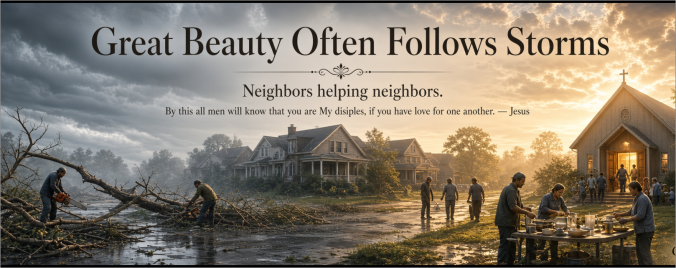
Great beauty often follows storms. Don’t get me wrong. The loss of life is horrible; the destruction of property, livelihoods, and displacement of families is heartbreaking. Yet, amid all this stress and pain, we will find beauty as neighbors and strangers step up to help however they can. Some will perform searches; some will open their homes, businesses, and church buildings; some will provide food and water; others will bring labor, chainsaws, and tools; others will gather supplies and clothing for victims. There will always be some evil; however, masses of good people from all over our nation will come together to help.

Although our news constantly tells us how much we hate each other, helping others should not be about skin color, language, or who we vote for. Good-hearted people show compassion as they strive to help one another. This is a real strength of America: neighbors who care about other people’s well-being.

This is the real America: where people step up in times of crisis to help others. This neighborly help is a real strength of America. Our pledge says “one nation under God,” and our money says “In God We Trust.” These mottos are not biblical claims that every helper, or the nation itself, is a follower of Christ but for disciples, the care goes further. It is the love of Christ at work through us. “A new commandment I give to you, that you love one another, even as I have loved you, that you also love one another. By this all men will know that you are My disciples, if you have love for one another.” — Jesus (John 13:34–35)

See: John 13:34–35; Luke 10:25–37; Galatians 6:10; Romans 12:15; Matthew 25:35–40; Micah 6:8; 1 John 3:17–18; Hebrews 13:16; Proverbs 14:21; James 2:15–16.

God First!

It’s Not Luck—It’s Christlike Caring

It’s Not Luck; It’s Caring!

Before Alzheimer’s, some had commented on how lucky we are to have a relationship that works so well. Alzheimer’s has affected us, yet the following principles still apply.

It is largely because we aim to please—not just ourselves, but each other. Our actions are mindful, considerate, and inclusive, so we do many things together. The “me, me, me” attitude of today’s culture is destructive to relationships and opposes the teachings of Christ.

It is all too common to exclude loved ones with activities that distract rather than encourage communication and interaction. Time is one of our most valuable earthly blessings; seize its blessings with every breath you take.

See: Philippians 2:3–4; 1 Corinthians 13:4–8; Ephesians 5:25, 28; 1 Peter 3:7; Ecclesiastes 4:9–12; Proverbs 18:22; Proverbs 3:3–4; Song of Solomon 8:7; Ephesians 4:2; Romans 13:8–10; Mark 12:31; John 15:12; Matthew 22:37–39; Colossians 3:12–14; 1 Corinthians 16:14; Galatians 6:2

God First!

Vote Because of Faith, Not Instead of It

It is because of my faith that I cast a vote for a viable candidate, not in place of my faith.

When Christians are silent, one voice is left speaking. In a republic our vote is one of the ordinary means God has given us to restrain evil and protect the freedom to do His will. Jesus’ parable of the talents (Matthew 25:14–30) teaches stewardship. The servant who buried what he had been given was called wicked and lazy, and what he held was taken away. The point is not that voting is a sacrament. The point is that opportunities entrusted to us are not to be hidden out of fear or indifference.

I was asked, “Shall we stand before the Lord and say, ‘Yes, I sided with evil and gave it my vote, but at least I did something’?” No. Those who vote can in substance say: “Lord, there were no perfect people on the ballot. I used the voice You allowed me in this country and supported the platform that most nearly let Your people keep doing Your will and speaking the gospel freely.”

Christ said, “For the Son of Man came to seek and to save the lost” (Luke 19:10). If Christians do not vote, they leave the field to those who do not share our mission. How does allowing non-believers to take over the field help us reach the lost with the message of Christ?

The Bible is our standard for right and wrong. We are to lead and teach with discernment, not hide the light under a basket because evil is present (Matthew 5:14–16). Evangelism is not limited to a pulpit. It includes the choices we make wherever we can still act.

My hope is not pinned on politics or on men. Jesus gave us a purpose, and we are obligated to pursue it with the means He provides. In this nation the vote is a means we have been provided to help us protect our right to freely share Christ rather than watch that freedom narrowed or removed.

Today the differences on the ballot are not small. One set of policies treats the intentional killing of the unborn—including children late in pregnancy—as a right to be protected and even celebrated. Scripture calls the shedding of innocent blood an abomination (Proverbs 6:16–17; Jeremiah 1:5; Psalm 139:13–16). Another set of policies promotes the medical alteration of children’s healthy bodies in the name of gender identity, sometimes against the wishes of parents, and places males in female sports and private spaces. Jesus affirmed that God made them male and female from the beginning (Genesis 1:27; Matthew 19:4). Schools are also being used to present these confusions to children as normal. These are not minor policy disagreements; they contradict the Word of God. Isaiah warns, “Woe to those who call evil good and good evil” (Isaiah 5:20).

At the same time, a vote can defend concrete goods: the life of the child in the womb, the right of parents to direct the upbringing of their own children, the privacy and fairness of women’s spaces and sports, the freedom of churches and believers to speak biblical truth without penalty, and the ordered liberty that lets the gospel be proclaimed.

We are not electing saviors. We are using one ordinary means God has given in this republic to restrain what God Himself calls evil and to protect the freedom to do what He calls good.

Political correctness often functions as a harness on truth. If we keep restraining truth, we will eventually fail to recognize it.

If Christians stop sowing, we should not be surprised when Satan’s seed fills the field. Our vote is a tool for standing against evil and for Christ. It is like the well-known picture of the man in a flood who refuses every boat and helicopter, insisting God will save him, and then drowns. God often works through the ordinary help He sends. Refusing the means is not faith.

“If I never make a difference, it won’t be because I didn’t try.” ~Wayne R Johnson

See also: Genesis 1:27; Exodus 20:13; Psalm 139:13–16; Proverbs 6:16–17; Isaiah 5:20; Jeremiah 1:5; Matthew 5:13–16; Matthew 19:4–6; Matthew 25:14–30; Luke 19:10; Ephesians 6:4; Romans 13:1–7; 1 Peter 2:13–17.

God First!

Be the Church Christ Purchased with His Blood

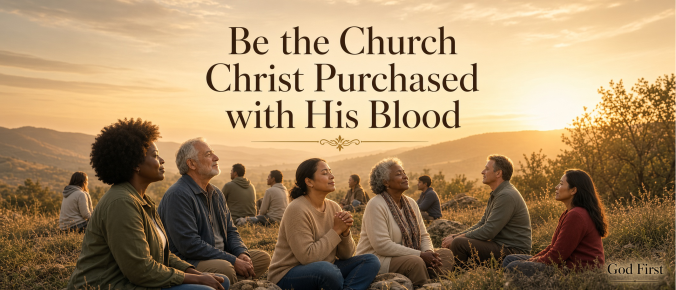
Who is the church? The church is not a building. It is the people Christ purchased with His own blood (Acts 20:28). They are those who have repented and been buried with Him in baptism for the forgiveness of sins, raised to walk in newness of life, and added by the Lord to His body (Acts 2:38, 41, 47; Romans 6:3–4; 1 Corinthians 12:13). Scripture calls us to follow Christ and to handle His word accurately, to the glory of God (Matthew 7:21; 2 Timothy 2:15).

“We were buried therefore with him by baptism into death, in order that, just as Christ was raised from the dead by the glory of the Father, we too might walk in newness of life” (Romans 6:4). All of us who have been baptized into Christ Jesus were baptized into His death (Romans 6:3). In one Spirit we were all baptized into one body (1 Corinthians 12:13).

Attending Bible classes and worship whenever we can helps us draw near to God. “Draw near to God, and He will draw near to you” (James 4:8). Each class, worship service, prayer, and song turns our minds toward our Creator and reminds us whose we are.

As disciples of Christ and members of His body, our times together teach us to love and encourage one another as we seek a clearer understanding of God’s will (Hebrews 10:24–25). Each visit is an opportunity to share our lives, bear one another’s burdens, and become better equipped to resist temptation. We are reminded of Jesus’ love and sacrifice, and of the forgiveness He offers when we repent and keep His commandments (John 14:15; 1 John 1:7–9). We compare our choices with His word and, when we need to, turn again in repentance.

We are not alone in the challenges, victories, and pains of life. We shake hands, embrace, listen, laugh, cry, and pray together, turning our burdens over to Jesus and helping each other in what ways we can (2 Corinthians 1:3–7).

Together we give thanks to God in worship, prayer, and song, and we let that gratitude show in our words and example. As we study, we strengthen our resolve to follow Christ and keep His commandments, so that others may see the hope that is in us and ask why (1 Peter 3:15). We want them to know the joy and peace of being in Christ, and what it is to walk through this world with our Savior’s help.

Christ loved the church and gave Himself up for her, so that He might present her to Himself in all her glory, having no spot or wrinkle or any such thing, but that she would be holy and blameless (Ephesians 5:25–27). He prayed that those who believe in Him through the apostles’ word may all be one, even as the Father is in Him and He in the Father, so that the world may believe that the Father sent Him (John 17:20–21). And He charged His people: “Go into all the world and preach the gospel to all creation. He who has believed and has been baptized shall be saved; but he who has disbelieved shall be condemned” (Mark 16:15–16).

For those near us, you are invited to join this journey of study and worship.

Buford Church of Christ
1135 Chatham Road
Buford, GA 30518 Sunday: 9 am | Bible class, in person (all ages)
10 am | Worship, in person and online
6 pm | Worship, in person and online Wednesday: 7 pm | Bible class, in person and online To God be the glory.

God First!

If Jericho Fell on the News: Would We Alter the Gospel?

While listening to Joshua’s account of the fall of Jericho in the Old Testament, I wondered how it would be received in today’s world of Social media and live news feeds. I imagine the media would explode with interviews, conjecture, ridicule, and laughter run-amok. Would there be even one media source that would not be mocking these followers of God who say their God is the “One and Only God” in my opinion, the sarcasm would be relentless.

Can you envision the video they would capture or the reporter’s words? “These people actually believe the huge city walls in this video will collapse if they march around the city once a day for six days while staying quiet, and then on day seven march around the city seven times with priest blowing trumpets; then, at the sound of one last trumpet, they believe all they have to do is yell, and this massive wall, this huge massive wall of Jericho, is going to fall down so they can take the city”

Can you imagine the news coverage? How about the jaw-dropping shock to the world of unbelievers when the wall falls?

Do you think the walls of Jericho would have fallen if they had done anything less than what God commanded them to do? The same God who specified the march also specified how a person comes into Christ. Hebrews 11:30 says the walls fell by faith after they had been encircled for seven days. The city had already been given (Joshua 6:2); the marching did not earn it. The promise was attached to the instructions, and the result came when those instructions were kept

For some reason, many today take huge liberties with God’s word and make statements along the lines of, “God loves us; Jesus died for us, and because He loves us, we don’t need to be baptized (immersed) to be saved. We don’t need to gain understanding, repent, confess Jesus as Lord, or change our life; all we have to do is say a prayer, and we are saved, and once we are saved, we are always saved.

Scripture does not present a prayer as the converting act. It names belief, repentance, confession, and baptism for the forgiveness of sins (Mark 16:16; Acts 2:38; 22:16; Romans 10:9–10). A changed life follows that response; it is not a work done beforehand to earn it (Romans 6:4; John 14:15). Passages on security address those who continue in Christ (John 10:28–29; Romans 8:38–39). They do not cancel the warnings against falling away we find in (Hebrews 3:12–14; 10:26–29; 2 Peter 2:20–22).

What if a priest in Joshua’s camp said, 7 times is unnecessary; God loves us; let’s pray, then blow the trumpets and yell, ‘God is with us! Or any other variance from God’s command. Do you really believe the walls would have fallen had anything less than God’s command been done?

I don’t!

God attached the promise to the instructions He gave. The walls fell when those instructions were kept (Joshua 6:20). I do not believe a substituted plan would have brought the same result.

The walls would never have fallen if they had done anything other than what God told them to do. In 2 Kings 5:14, Naaman was told to dip seven times in the River Jordan to heal his leprosy; He first wanted a different method. He was cleansed when he dipped seven times “according to the saying of the man of God. ”had he tried to sprinkle water on his body or do anything else, he would not have been healed because he did not do as God commanded. We are told to teach the message of Christ with boldness and love, not by changing the message to get more people to listen or respond. Doing so is foolish!

Christ’s blood is the ground of forgiveness. Faith, repentance, confession, and baptism are the conditions God set for receiving it—not works that earn it.

Throughout Scripture, we have words and examples showing that it is important to do God’s will, God’s way, as stated in His Holy Word, not our own desires. This was true then, and it’s true now.

Jesus tells us, “If you love Me, you will keep My Commandments.” God specified the way at Jericho. He has specified the way now.

Hebrews 11:30; Joshua 6:2–5, 20; 2 Kings 5:10–14; Mark 16:16; Acts 2:38; 22:16; Romans 6:3–4; Galatians 3:26–27; 1 Peter 3:21; John 14:15; Matthew 7:21; James 2:14–26; Hebrews 5:9.

God First!
Millions Estimated Lost—Eight Were Saved

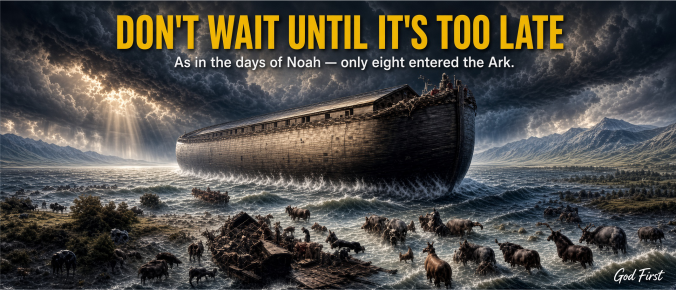
Scholars estimate that millions were living on Earth at the time of the great flood. Noah, a preacher of righteousness, spent decades building an Ark on dry land and, while building it, also preached righteousness before the impending flood. Many probably thought Noah was nuts, at least until the day the rain fell. The day reality set in, the day it was too late to act. (Sound familiar)

Today, science, archaeology, history, and Scripture provide overwhelming evidence that Jesus lived, died, and was raised again. Today, God-breathed, inspired Scripture shows us how, through belief and obedient faith, we can repent, confess Christ, and be Immersed “In Christ,” buried in the waters of baptism for the forgiveness of our sins. Scripture tells us of Christ’s return, His judgment, and how, by God’s grace and our obedient faith, we can look forward to receiving new glorified bodies, living forever with Christ in heaven and forever with our brothers and sisters “in Christ.”

Unfortunately, just like with the rejection of Noah, the message of Christ is constantly being rejected or skewed. Those sharing the truth of His message are often ridiculed and dismissed as religious fanatics for attempting to share the news of Christ with the hope that people will react and respond.

Christ is the most important message you will ever hear. Please don’t wait until it’s too late to act.

Do a self-check, do a biblical check, and be certain the path you’re on is the path God set before us all in His Holy Word, not a rendition of truth crafted by those who tickle ears. (see: 2 Timothy 4:3–4)

Accepting God’s love includes accountability.

  • Romans 14:12
  • 2 Peter 2:5
  • Hebrews 11:7
  • Genesis 6:5–22
  • 1 Peter 3:20–21
  • Romans 10:17
  • Mark 16:16
  • Acts 2:38
  • Romans 10:9–10
  • 2 Timothy 2:15
  • 2 Timothy 4:3–4
  • Philippians 3:20–21
  • Romans 6:3–8
  • see also: Genesis 7:1, 5, 16, 21–23; Genesis 9:19; Matthew 24:36–44; Luke 17:26–27; John 3:5; Acts 2:36–41; Acts 22:16; 1 Corinthians 15:51–53; Ephesians 2:8–10; Colossians 2:12; 2 Timothy 3:16–17; 2 Peter 3:3–13; 1 John 1:7           

God First!

God’s Greatest Commandments: Love Him First, Love Others Always

Jesus answered, “The most important is, ‘Hear, O Israel: The Lord our God, the Lord is one. And you shall love the Lord your God with all your heart and with all your soul and with all your mind and with all your strength.’ The second is this: ‘You shall love your neighbor as yourself.’ There is no other commandment greater than these.” And the scribe said to him, “You are right, Teacher. You have truly said that he is one, and there is no other besides him. And to love him with all the heart and with all the understanding and with all the strength, and to love one’s neighbor as oneself, is much more than all whole burnt offerings and sacrifices.” Mark 12:29-33

Matthew records the same teaching this way: “On these two commandments depend all the Law and the Prophets” (Matthew 22:40). They do not erase the rest of God’s will. They show what every command is for: wholehearted love for God, and real love for people.

  • Love God with all your heart, soul, mind, and strength.
  • Love your neighbor as yourself.

“Love your neighbor as yourself” assumes we already seek our own good; it does not teach self-worship but we cannot claim love for God while refusing to love others as ourselves. These are not mutually exclusive (1 John 4:20–21)

Jesus calls us to follow Him daily. He knows what is best for us. Luke 9:23 says that following Him means denying ourselves and taking up the cross daily. Are we drawing closer to Him in prayer and study? Or are we so occupied with everything else that we rarely think of our Savior, or even take time to pray?

Jesus does not treat love as a warm feeling we can have while ignoring what He said. “If you love me, you will keep my commandments” (John 14:15). He also gave a new command: love one another as He loved us—not only as we love ourselves (John 13:34; John 15:12–13).

That’s A LOT OF LOVE!

“Draw near to God, and He will draw near to you. Cleanse your hands, you sinners; and purify your hearts, you double-minded.” James 4:8

In the above verse, James calls double-minded people to repent. Drawing near means turning from a split loyalty—not merely adding a brief prayer to a crowded day.

In Christ we can have the peace of God, which surpasses understanding, as we bring our requests to Him with thanksgiving (Philippians 4:6–7). Prayer, however, is not a substitute for the Word. God’s Word cannot teach us if we leave it closed. “Do your best to present yourself to God as one approved… rightly handling the word of truth” (2 Timothy 2:15).

  • 2 Timothy 2:15
  • John 13:34
  • John 14:15
  • Mark 12:29-33
  • Matthew 22:40
  • Philippians 4:6–7
  • 1 John 4:20–21
  • James 4:8
  • Deuteronomy 6:4-5; Leviticus 19:18; John 15:12-13; Romans 13:8-10; Galatians 5:14; 1 John 4:7-11, 19-21; Luke 9:23; Philippians 4:6-7;

God First!

40 Christians on a Bus: Will the Driver Meet Christ Through Us?

40 Christians on a tour bus for the week. A day has come and gone. How many of us will get to know the bus driver’s name? Is he married? Does he have children? Is he a Christian? Does he believe in Jesus? Is he in Christ?

By the end of the week, will the bus driver think of us as “good Samaritans”? As 40 Christ-loving, Christ-sharing people concerned for his well-being, for his soul, Christians willing to invest a little vacation time sharing the love of Christ with this stranger, or will we be just another group of people he drove around for the week?

This is a challenge for all Christians as a group or as individuals. Will we plant the seeds of truth in all that we do? Will those we meet know more about Christ’s love for them after we’re gone than they did before we met them?

“And he said to them, “Go into all the world and proclaim the gospel to the whole creation.” – Mark 16:15

Do nothing from selfish ambition or conceit, but in humility count others more significant than yourselves. – Philippians 2:3

 A new commandment I give to you, that you love one another: just as I have loved you, you also are to love one another. – John 13:34

Rhetorical question: How can we claim to love others and not seek every opportunity to share the most essential message of our lifetime? Christ is the soul-saving message that offers eternal life in heaven!

We should do our best to plant the seeds of Truth in all we do and use the opportunities God places in front of us—whether a week-long tour or a five-minute conversation. Plant the seed. God gives the increase

“And let us not grow weary of doing good, for in due season we will reap, if we do not give up. So then, as we have opportunity, let us do good to everyone, and especially to those who are of the household of faith.” Galatians 6:9-10

see also: Matthew 22:37-39; Luke 10:25-37; Acts 8:4; Romans 10:14-15; 1 Corinthians 9:19-23; 2 Timothy 4:2; 1 John 3:18.

God First!

Write It Down, Cast It on Him

I once found myself extremely stressed as multiple concerns snuck up, combined, and weighed me down. I remember feeling so distraught and so overwhelmed I knew not what to do. Then I decided to write down my thoughts. Not for the purpose of sharing them with others, but to take those muddy thoughts in my mind, organize them, and put them somewhere else—like on paper. For some reason, this helped me think more clearly in the following days. It helped me prioritize my thoughts and clear away the mud in my mind.

I still do this from time to time. In fact, if you’re reading this, you see that I share some thoughts on social media and web platforms, but certainly not all.

I have also found that it’s just as important to read those thoughts back later as it is to write them down, even if what I wrote looks like incoherent Babel. That can be embarrassing if I have shared it publicly, but that doesn’t matter.

What matters is this: writing my thoughts down and rereading them helped clear my mind. It helped me identify the issues and separate what I could control from what I could not.

If you’re struggling in some way, writing might help. Take a little time and write for yourself, even if no one else ever reads it. Writing may help you think more clearly, as it did for me. But remember, writing is only a tool. Paper holds words. Jesus carries the burden if we will pray, turn those cares over to Him, and trust Him to help.

Scripture tells us to humble ourselves by casting our anxieties on God. So pray first, or pray as you write. You may even write out the prayer itself, telling God what is on your mind. That helps you recognize the anxieties you cannot control so you can turn them over to the One who can: Jesus. Then trust Him to carry that load.

“Humble yourselves, therefore, under the mighty hand of God so that at the proper time He may exalt you, casting all your anxieties on Him, because He cares for you.” 1 Peter 5:6–7

See also: 1 Samuel 1:10–18; Psalm 13:1–6; Psalm 42:5; Psalm 55:22; Psalm 62:8; Proverbs 3:5–6; Lamentations 3:19–24; Matthew 6:25–34; Matthew 11:28–30; Luke 12:22–31; Philippians 4:4–7; Hebrews 4:14–16; 1 Peter 5:5–9.

God First!

« Older posts Newer posts »

© 2026 Advocate for Christ

Theme by Anders Noren — Up ↑