The best life is a God First life

Month: October 2026 (Page 1 of 2)

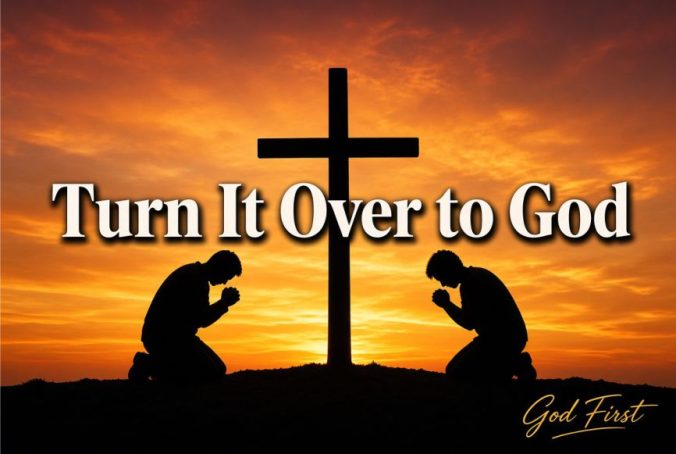
Turning It Over to God Is Not Trite—It’s Trust

Sometimes, it sounds trite to say, “JUST TURN IT OVER TO GOD,” but this is where our trust in God, faith, and belief come into play. When Christians strive to follow Christ with obedient faith, we are striving towards righteousness. In (Mark 11:24) we are told, “Therefore I tell you, whatever you ask in prayer, believe that you have received it, and it will be yours.” So, how do we turn it over to God? Well, we pray, we believe, and we trust in God’s answer, which allows us to let it go.

I once became so consumed by my concern for a loved one that it affected everything I did, including my marital relationship, until the day I realized that all my attempts to help this person were nothing more than temporary fading patches. Both I and my loved one needed to know that God was the answer, NOT ME or anything else. I asked myself, who would be there for them if I was gone? As I thought about my question, I realized God was the only answer! So, that night, I got on my knees and fervently prayed through heartfelt tears. I begged and pleaded in anguish and fear, asking God to help them, asking God to put people in their lives who could help them. I know that God’s will is the best will for all of us, so I took my cue from Christ’s example in the garden, and I asked that God’s will be done. I turned my cares over to Jesus.

My prayer that night wasn’t me giving up on that person in any way. I just realized, as never before, that God has complete control, and mine is extremely limited. That night, I literally felt a great invisible weight removed from my shoulders, replaced by a trusting calm.

After this prayer, when I heard from this person about self-inflicted difficulties, I limited my involvement and encouraged them to seek God’s will and pray; I offered to pray with them. To this day, I still pray for this person every day, and they have come a long way from those days and now include God in all that they do.
Romans 8:28 says, “And we know that for those who love God all things work together for good, for those who are called according to his purpose.” In 1 Peter 5:6-7, “Humble yourselves therefore under the mighty hand of God, that he may exalt you in due time: Casting all your care upon him; for He careth for you.”
In summary, don’t allow yourself to be consumed by things you can’t control. Turn them over to God! Pray and seek help from the one who can help when no one else can, the one who created everything you see and know, the one who created you and loves you like no other – The God of Love, who is Love.

When Christians strive to follow Christ with obedient faith, we are striving towards righteousness. When we turn that which we cannot control over to God, it’s not trite; it’s where our trust, faith, and belief come into play and substantiate our trust in God. God is love and will carry us through. For Christians, this world is not our home. Christians look forward to the fact that there will be no tears in heaven. By putting God First in our lives, we make this world a better place by our loving actions.

God’s word tells us to hear, believe, repent, and confess the name of Jesus and be immersed in the watery grave of baptism for the forgiveness of our sins. In (Acts 2:38) we find in doing so, we receive the gift of the Holy Spirit. Only by doing so and living righteously theirafter, can live knowing that heaven is now our eternal home.

Hearing: – Romans 10:17, John 8:32
Belief/Faith: – Hebrews 11:1, John 8:24, Romans 10:17, Acts 3:19
Repentance: – 2 Cor. 7:9-10, Luke 13:3-5, Acts 17:30
Confess: – Romans 10:9-10, Matthew 10:32-33, Luke 12:8-9
Baptism by immersion for the forgiveness of sin: – Matthew 16:15-16, 1 Peter 3:21, Acts 2:38, Mark 16:16, John 3:5, Matt 28:18-20, Ephesians 4:5, Romans 6:3-4, Colossians 2:12, Acts 8:36-39, Mark 1:9-10, John 3:23

God First!

Pray, Vote, and Share the Gospel

Our USA election is no surprise to God. He knows all and sees all. At the same time, our prayers are important to Him. We are to pray without ceasing, for understanding, for wisdom, with faith, for our leaders, and for peace. Scripture tells us that the prayers of the righteous have great power. We are also given examples of times when failing to seek God’s counsel or remaining passive was not pleasing to Him (Joshua 9, the Parable of the Talents, Esther).

So let’s pray for our country now. Let’s pray that our choices will not hinder our ability to share the Gospel of Christ, but will help and encourage it. Let’s pray that we vote for candidates who use their voice, policies, and actions to stand against the acceptance of evil as the norm, and whose leadership best aligns with God’s will.

I pray that, during and after this election, all of us who consider ourselves Christians will do a better job of spreading the gospel to the world—especially to the leaders of our own country. God desires that everyone hear the gospel, including politicians. The closer they draw to God, the better they understand His principles and standards, and the better they can discern what is right.

“It will also come to pass that before they call, I will answer; and while they are still speaking, I will hear” (Isaiah 65:24). This promise describes the close fellowship God’s people will enjoy in the new heavens and new earth. Even now, He hears the prayers of the righteous, so we can pray with confidence while we wait for that perfect day.

I urge anyone reading this to pray. Pray now and pray often.

See: 1 Thessalonians 5:17; James 1:5–6; 1 Timothy 2:1–2; James 5:16; Joshua 9:14–15; Esther 4:14; Matthew 25:14–30; Mark 16:15; Isaiah 65:24; Romans 13:1; Proverbs 14:34; 1 John 5:14.

God First!

A Lie Called Spin Is Still a Lie

How many of us choose the perfect words every time we speak or write? None of us. How many of us when we write create the perfect sentence, paragraph, post, or blog? None of us. Yet today many attack the exact wording someone used while ignoring the clear and obvious intent behind it.

Jesus once said to a group of accusers, “Let him who is without sin among you be the first to throw a stone at her” (John 8:7). In that specific setting He exposed their hypocrisy—they were willing to condemn the woman while themselves violating the Law’s requirements. The principle still applies: imperfect people should not rush to cast stones over wording or presentation while overlooking obvious intent or their own faults. At the same time, Scripture holds us accountable for the words we actually speak (Matthew 12:36–37). Both the heart and the tongue matter.

How many imperfect people are casting stones at someone right now, NOT because of their intent, but rather because we did not like the words they used, how they presented them, or what they were told the words meant?

In politics and media, twisting truth is often expected and done on purpose. Instead of calling these efforts what they are—deceit or lies—they are proudly labeled “spin” or “gaslighting.” Phrases such as “that’s their spin,” “what’s your spin?” or “they’re gaslighting you” have become commonplace. The intent of spin and gaslighting is to confuse, distort truth, shift the focus, and weaken the impact of what was originally said, no matter how sound the original words.

Someone once shared that in media they were told, “Never let the truth get in the way of a good story.” How sad. If it looks and sounds like a duck, it’s a duck. A lie called spin or gaslighting is still a lie.

To counter these techniques we must have the truth. While absolute truth is almost impossible to obtain from politics and media, it is not impossible when it comes to God and our salvation. We have absolute truth in the complete Word of God. Jesus prayed, “Sanctify them in the truth; your word is truth” (John 17:17). God’s Word is our standard on all things; the answers are there for us to follow.

God is not a God of confusion (1 Corinthians 14:33). That statement was given in the context of orderly worship, yet the principle remains: God is the God of peace, order, and truth—not of deceitful chaos. Therefore we are called to put away falsehood and speak the truth in love (Ephesians 4:15, 25), and to test everything by Scripture (1 Thessalonians 5:21).

“Seek, and you will find” (Matthew 7:7). When we seek God through His Word, we find the unchanging truth that exposes every form of spin.

See: John 8:7; 1 Corinthians 14:33; Matthew 7:7; Exodus 20:16; Proverbs 12:22; Ephesians 4:25; Colossians 3:9; John 17:17; John 8:44.

God First!

No Non-Church Days: We Are the Body of Christ

As Christians, there are no non-church days. We are the church. We do not stop being the church when the assembly ends. We are the church, the body of Christ, 24/7. Paul makes this plain: After describing how God rescued us from the domain of darkness and transferred us into the kingdom of His beloved Son, he writes:

“He is also head of the body, the church; and He is the beginning, the firstborn from the dead, so that He Himself will come to have first place in everything. … And although you were formerly alienated and hostile in mind, engaged in evil deeds, yet He has now reconciled you in His fleshly body through death, in order to present you before Him holy and blameless and beyond reproach—if indeed you continue in the faith firmly established and steadfast, and not moved away from the hope of the gospel that you have heard… Now I rejoice in my sufferings for your sake, and in my flesh I do my share on behalf of His body, which is the church…”
(Colossians 1:18, 21–23, 24 NASB1995)

Christ is the head of the body now. We are members of that body now. The transfer into His kingdom and the reconciliation accomplished through His death are not limited to one day of the week. Our identity as the church is non-stop.

This is why Paul also states, “Now you are the body of Christ and individually members of it” (1 Corinthians 12:27 ESV). We do not become the body only when we gather; we gather because we already are the body. The local assembly is essential ( see: Hebrews 10:24–25), but our belonging to Christ and to one another does not turn on and off with the church calendar.

There are no non-church days for those who are in Christ. Every day we live as members of His body, under His headship, continuing in the faith and seeking to present ourselves holy and blameless before Him.

See also: Colossians 1:13–24; 1 Corinthians 12:27; Ephesians 1:22–23; Romans 12:4–5; Ephesians 5:30; 1 Peter 2:9; Hebrews 10:24–25.

God First!

In Christ We Find Refuge: Comfort When Storms Rage

So many of us look at the wreckage of storms, the sudden loss of life, the weight of sickness, the shock of accidents, or other heartbreaking tragedies and want to blame God. I know this temptation. The questions rise quickly: Why, God? Why me? Why us? Why such good people?

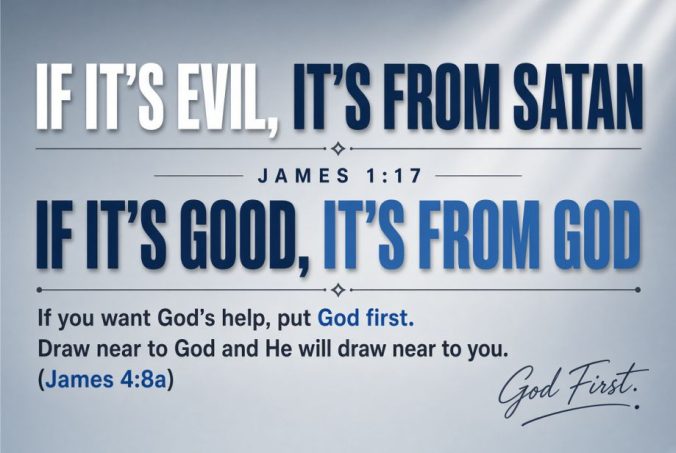
Yet Scripture is clear. Moral evil, including temptation to sin, the intent to destroy, and every effort to separate us from our Creator, comes from Satan, not from God. Only good gifts come from the Father of lights (James 1:17). God cannot be tempted by evil, and He Himself tempts no one (James 1:13). He never entices us toward sin. Instead, when trials come, He is faithful to provide a way of escape so we can endure (1 Corinthians 10:13).

Those who are in Christ can be comforted even in the worst storms, whether the storm is physical or deeply personal. God is our refuge and strength, a very present help in trouble (Psalm 46:1). He is the Father of mercies and the God of all comfort, who comforts us in every affliction so that we, in turn, can comfort others (2 Corinthians 1:3–4).

The path to peace and lasting comfort in this fragmented world is not found in demanding answers for every “why.” It is found in keeping our primary focus on drawing near to God, receiving His grace by doing His will, living with grateful hearts, and remembering the sacrifice of Jesus and the message of eternal life He secured for us. Satan wants nothing more than to drive a wedge between you and God in the middle of your pain. Do not let him.

In Christ we find refuge.
Satan is the evil one.

God First!

(See: Psalm 46:1–3; James 1:13–17; James 5:16; 2 Corinthians 1:3–5; 1 Corinthians 10:13; Romans 8:20–22; John 10:10; 1 Peter 5:8; James 4:8)

Love Does Not End at Death: Lessons from the Rich Man and Lazarus

(The Rich Man and Lazarus) I heard a preacher point out that this is more of an illustration story than a parable because it uses a proper name.

One of many lessons we can gain from this story is that a person continues after death. Whether in the Paradise portion of Hades or the Torment side, recognition, memory, concern, and awareness continue. The rich man wanted to warn his family and was told, “They have Moses and the Prophets; let them hear them.” God’s Word was their opportunity then. Today we have Jesus and the completed God-breathed words of Scripture.

“Love does not end at death.”

God’s Word is the pathway by which people come to know their Creator and trust in Jesus—the only way to the Father (John 14:6).

Matthew 22:37 commands us to love the Lord our God with all our heart, soul, and mind. This story shows that the person (the conscious soul/spirit) continues with memory, recognition, and concern after the body returns to dust.

This account is found in Luke 16:19-31. Other clear points include recognition, remembrance, concern for others, pain, the fixed chasm, and the fact that there is no second chance. Our time is now.

See: Luke 16:19-31; Luke 23:43; 2 Corinthians 5:8; Hebrews 9:27; John 14:6; Matthew 22:37; 1 Corinthians 13:1-13 (especially 13:8).

God First!

One of the best things my brother did was hurt me with love

One of the best things my little brother ever did for me is something many would not understand, and some would disagree with. Admittedly, when he decided to take action, I thought he was being ridiculous. I understood his intent but gave little thought to the strength and courage it took him to take the stance. I know now his reasons were sound, but back then, I was so wrapped up in my life I wasn’t about to listen. Instead, I acted as if it was “his” choice and dismissed his decision, although down deep, it bothered me.

At that time in my life, I was a young baptized man with a “milk feed” understanding of scripture. Although I knew better, I had allowed myself to slowly become consumed in worldly ways. Although mindful that I was on the wrong path, I ignored my bad choices rather than change direction. Instead of turning back, I stopped referring to myself as a Christian and convinced myself I did not want to seem like a hypocrite or bring reproach to the Lord’s Church, so I stopped attending services.

For some reason, I thought this was logical, but in reality, I didn’t want anyone to convince me I needed to change. So, I wouldn’t give them a chance. Instead, I ignored or avoided them and, in effect, ignored and tried to avoid God. I would smile, cut jokes, “always had to go,” anything to avoid giving birth to a serious conversation.

In later years, I realized that by my choices, I had been denying Christ, turning my back on His love, and crucifying Jesus yet again. (Oh, how much this hurts to think about now.)

My parents and brother tried to talk with me about my choices and what God’s Word says about my decisions, but I would have nothing to do with it. These conversations were like the plague to me. I didn’t want to risk changing my lifestyle, so I tried to ignore them. I feared conflict because it might lead to a sense of accountability or change, and I feared change might rock my relationships.

In retrospect, I was a cowardly man who perceived myself as strong and good. I played a dangerous game and gambled my soul, thinking, “God will take me back when I’m ready,” This was arrogant and foolish.

Somehow, I thought if I died, I could explain to Jesus how things came about and, because of His great love and understanding, Jesus would cut me a break. He would understand and forgive me. I think I actually thought myself so sly that I could talk my way out of eternal punishment by pleading ignorance.

Deep in the recesses of my mind, I wanted to follow Christ and secretly hoped I would man up. I recall praying from time to time that it wouldn’t take some significant loss or terrible event to get me serious about changing direction.

The truth is, it was not really a gamble at all; had I died at that time of my life, I was lost for eternity. My keen wit and ”worldly sorrow” would NOT have saved me. It would take ”Godly Sorrow.” Why? Because Godly sorrow leads to repentance. I was wrong and needed to realize it; since I was already baptized, I needed to repent (change direction), ask forgiveness for my sins, and live for Christ rather than myself.

Spiritually, I was in a worse condition than someone who had never known the way of righteousness (2 Peter 2:21). I was a baptized believer who chose Satan’s offerings over God’s grace and Christ’s Sacrifice.

My brother’s efforts were done out of love and designed to help me see the seriousness of my condition when he informed me that he would not bring his family to my home. While formal disfellowshipping is a decision of the local congregation, my brother’s refusal to bring his family into my home was a personal, loving application of the same biblical principle—protecting his household and refusing to treat ongoing rebellion as acceptable (1 Corinthians 5:11; 2 Thessalonians 3:14). To many, this sounds horrible, but it wasn’t! It was an extremely difficult act of concern and love for my soul. And what I needed. He was also protecting his family from my worldly influence because condoning my chosen lifestyle inferred acceptance of that which goes against the teachings of God. His goal was never permanent separation. Like the instruction in 1 Corinthians 5 and 2 Corinthians 2, the purpose of the withdrawal was to help me come to my senses so that fellowship could be restored.

Unfortunately, my brother’s actions alone did not get me to change, but they did prompt me to take pause and give some attention to the seriousness of my soul’s condition. Years went by, and I missed out on opportunities to influence my nieces in positive ways because of my choices at the time, not my brother’s. I chose a lifestyle I knew was contrary to scripture and contrary to living for Christ; I was living in sin, and very importantly, “I knew better!”

My brother’s action was a blessing; it was one of the best things he could have done. It was far from the first or last thing he tried. He continued to reach out to me, and we talked about Scripture occasionally. We would still see his family on special occasions. The withdrawal was never meant to be the end of the relationship—only a temporary, loving boundary until I turned back. My brother’s influence and actions at the time helped lead me back to Christ and an eternal home with God. Today, we are the best of friends and brothers in Christ.

Since my repentance several years back, I have studied diligently and realized how little I understood of God’s will, grace, forgiveness, and the importance of ”my role” in God’s plan. We cannot just receive; we must give!

I wish I had been consuming both the milk and ”the meat of Scripture” when I was in my youth. Thankfully, I knew enough to realize that I truly had no excuses as Godly sorrow took hold of me. I knew enough to realize I needed God’s forgiveness and that for me, as a baptized believer of Christ, that meant change (repentance), asking for forgiveness of God and the Church.

With today’s understanding of Scripture and God’s love, I cannot fathom living and NOT doing my best to put God’s will first in my life; after all, God’s will is the best will!

Love is sometimes difficult and sometimes hurts, but love always wins in the end. God’s forgiveness and God’s eternal home are available to all who will follow Him and pursue God’s will over their own.

God First!

  • James 4:17
  • 2 Peter 2:21–22
  • Philippians 2:10-11
  • Revelation 21:8
  • Romans 12:2
  • Ephesians 2:8–9
  • Hebrews 2:3
  • 1 Peter 2:2
  • Hebrews 6:4–6
  • 1 Corinthians 3:2
  • James 2:18
  • Hebrews 11:6
  • Luke 8:13
  • 2 Peter 3:18
  • John 15:1–6
  • 2 Timothy 3:12
  • 2 Timothy 4:10
  • Galatians 5:4
  • 1 Corinthians 13:1–13
  • 1 Corinthians 5:1–13
  • 2 Corinthians 2:1–17
  • 2 Thessalonians 3:1–18
  • Hebrews 12:1–29
  • Galatians 5:1–26
  • 2 Corinthians 7:10
  • Matthew 18:15–17

30 Characteristics of Agape Love: A Biblical Portrait

  1. Unconditional
  2. Without expectation of reciprocation
  3. Desiring good for others
  4. It’s eternal
  5. It is the greatest 
  6. It has no evil in it
  7. It covers a multitude of sins
  8. Provides motivation
  9. Brings peace
  10. It is a choice
  1. Fruit of the Spirit
  2. Not resentful
  3. God is love
  4. It’s forgiving
  5. Selfless
  6. Patient
  7. Kind
  8. Not envious
  9. Not boastful
  10. Not arrogant

  1. Not rude
  2. Does not insist on its own way
  3. Not irritable
  4. Does not rejoice in wrongdoing
  5. Rejoices in the truth
  6. Bears all things
  7. Believes all things
  8. Hopes all things
  9. Endures all things
  10. LOVE NEVER ENDS
  • It is the greatest (1 Cor 13:13 — “the greatest of these is love”).
  • Sacrificial even to the point of laying down one’s life (John 15:13).
  • Demonstrated toward sinners/enemies (Rom 5:8 — “while we were still sinners, Christ died for us”).
  • It fulfills the law (Rom 13:8–10; cf. Matt 22:37–40).
  • Perfect love casts out fear (1 John 4:18).
  • It is active, not merely words (1 John 3:18).
  • We love because He first loved us (1 John 4:19).
  • It is the bond of unity/perfection (Col 3:14).
  • Love one another as Christ loved us (John 13:34–35).

Agape love is choosing to love unconditionally; it never changes. We should love God with all our heart, soul, mind, and strength.

  • 1 Corinthians 13:4–8, 13; Galatians 5:22–23; 1 Peter 4:8; 1 John 4:8; Philippians 4:8–9; Romans 5:8; John 3:16; Ephesians 5:2; John 15:13; Colossians 3:14; Romans 13:10; Matthew 22:37–40.

Choices make a difference

Deuteronomy 30:15–20

15 “See, I have set before you today life and prosperity, and death and adversity;
16 in that I command you today to love the Lord your God, to walk in His ways and to keep His commandments and His statutes and His judgments, that you may live and multiply, and that the Lord your God may bless you in the land where you are entering to possess it.
17 But if your heart turns away and you will not obey, but are drawn away and worship other gods and serve them,
18 I declare to you today that you shall surely perish. You will not prolong your days in the land where you are crossing the Jordan to enter and possess it.
19 I call heaven and earth to witness against you today, that I have set before you life and death, the blessing and the curse. So choose life in order that you may live, you and your descendants,
20 by loving the Lord your God, by obeying His voice, and by holding fast to Him; for this is your life and the length of your days, that you may live in the land which the Lord swore to your fathers, to Abraham, Isaac, and Jacob, to give them.”

Joshua 24:14–15

14 “Now, therefore, fear the Lord and serve Him in sincerity and truth; and put away the gods which your fathers served beyond the River and in Egypt, and serve the Lord.
15 If it is disagreeable in your sight to serve the Lord, choose for yourselves today whom you will serve: whether the gods which your fathers served which were beyond the River, or the gods of the Amorites in whose land you are living; but as for me and my house, we will serve the Lord.”

Matthew 7:13–14

13 “Enter through the narrow gate; for the gate is wide and the way is broad that leads to destruction, and there are many who enter through it.
14 For the gate is small and the way is narrow that leads to life, and there are few who find it.”

John 3:16–18

16 “For God so loved the world, that He gave His only begotten Son, that whoever believes in Him shall not perish, but have eternal life.
17 For God did not send the Son into the world to judge the world, but that the world might be saved through Him.
18 He who believes in Him is not judged; he who does not believe has been judged already, because he has not believed in the name of the only begotten Son of God.”

Related passages (NASB1995)

  • Romans 10:9–10: “that if you confess with your mouth Jesus as Lord, and believe in your heart that God raised Him from the dead, you will be saved; for with the heart a person believes, resulting in righteousness, and with the mouth he confesses, resulting in salvation.”
  • Hebrews 2:3: “how will we escape if we neglect so great a salvation? After it was at the first spoken through the Lord, it was confirmed to us by those who heard,”
  • Hebrews 3:12–15: “Take care, brethren, that there not be in any one of you an evil, unbelieving heart that falls away from the living God. But encourage one another day after day, as long as it is still called ‘Today,’ so that none of you will be hardened by the deceitfulness of sin. For we have become partakers of Christ, if we hold fast the beginning of our assurance firm until the end, while it is said, ‘Today if you hear His voice, Do not harden your hearts, as when they provoked Me.’”
  • 2 Thessalonians 1:7–9: “and to give relief to you who are afflicted and to us as well when the Lord Jesus will be revealed from heaven with His mighty angels in flaming fire, dealing out retribution to those who do not know God and to those who do not obey the gospel of our Lord Jesus. These will pay the penalty of eternal destruction, away from the presence of the Lord and from the glory of His power,”

Thank You—And Why I Keep Writing

Thank you to everyone who reads the messages in Advocate for Christ. Writing and sharing these posts is one way I can do good and serve the Lord while caring for a loved one with Alzheimer’s (see Galatians 6:9). I don’t write for accolades. If something here encourages or challenges you, feel free to respond with a like, love, comment, or share—especially if you believe it could benefit someone else. That’s how these messages get seen and read on social media.

My hope is twofold:

  1. To strengthen, encourage, and inspire those who are in Christ to study, grow, and practically apply God’s Word to daily life. As iron sharpens iron, so one person sharpens another (Proverbs 27:17). I welcome respectful, Scripture-based conversation that helps us all grow.
  2. To share the message of Christ with those who do not yet know Him—those who are currently lost according to God’s Word. By turning from their own way (repentance) and trusting and obeying Jesus, they can receive forgiveness and the promise of eternal life. This change of life and doing His will flows from trusting Him. His yoke is easy and His burden is light (Matthew 11:28–30).

My intent is not that anyone believe my words simply because I said them, but that they spark further study. If what I wrote differs from what you believe, please clarify the difference with Scripture—not feelings. Our souls depend on it, and I want to know if I am wrong so I can correct it. How about you?

Today, much so-called wisdom is grounded in feelings that weaken, discount, or set aside truth. This artificial wisdom encourages apathy when following Scripture conflicts with someone’s preferences or ideas. God is unchanging, and His Word is unchanging.

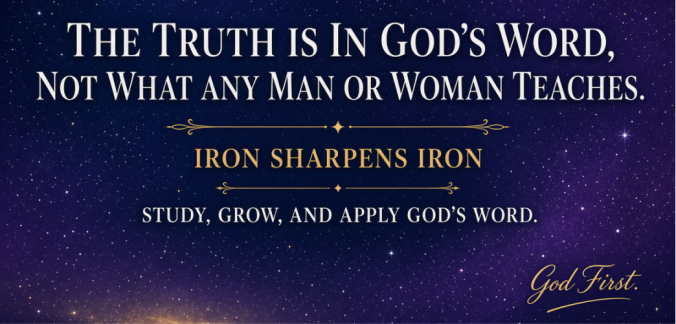
The truth is in God’s Word, not in what any man or woman teaches.

John 17:17; Proverbs 26:12; Proverbs 27:17; 2 Timothy 2:15; 1 John 4:1; Hebrews 4:12; Galatians 6:9; Matthew 11:28–30

God First!

« Older posts

© 2026 Advocate for Christ

Theme by Anders Noren — Up ↑