
On the day of Pentecost, when Peter preached the first gospel sermon, do you wonder why? Why is it that when Peter and the other Apostles (in Acts 2) were asked by the crowd whose hearts had just been pierced by the message of Christ,” Brothers, what do we do?”
Why did Peter NOT answer the crowd’s question with: “Accept Jesus into your heart and recite with me these words in a prayer, and you will be forgiven, you will be saved.”
WOW, if only the Apostle Peter, who was filled with the Holy Spirit, had known what many people claim today. That they could “just” accept Jesus into their hearts and recite a prayer to be saved; however, that’s “NOT” how Peter answered.
Peter never said, “baptism is an outward sign of an inward decision.” In fact, no such prayer is found in God’s Word. INSTEAD, Peter (filled with the Holy Spirit) tells them exactly what God wanted them to do… “And Peter said to them, ‘Repent and be baptized every one of you in the name of Jesus Christ for the forgiveness of your sins, and you will receive the gift of the Holy Spirit.” (Acts 2:38 ESV)
None of Peter’s responses indicates that any of God’s instructions were mutually exclusive.
In verse 41, God’s Holy Word says: “So those who received His word were baptized, and there were added that day about three thousand souls.” (Acts 2:41 ESV)
So, right after they received the message of Christ, they immediately followed the Apostle’s instructions and were immersed in the waters of baptism. They could have set appointments; they could have done so in small groups over weeks, but instead, we find urgency is implied: “So those who received His word were baptized, and there were added that day about three thousand souls.” (Acts 2:41)
That day, about 3000 souls were added to the Church! (Don’t you know that took a while?)
These scriptures show us that hearing, believing, repenting, and being baptized in the name of Jesus Christ is how we obtain the Holy Spirit.
Who did the adding? Who was being saved? Verse 47 “praising God and having favor with all the people. And the Lord added to their number day by day those who were being saved.” (Acts 2:47 ESV)
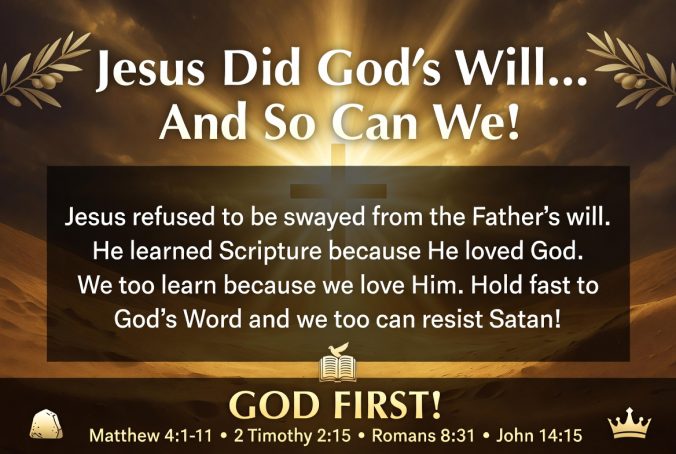
Please, don’t take my word for it. Take God’s word for it. “Do your best to present yourself to God as one approved, a worker who has no need to be ashamed, rightly handling the word of truth.” (2 Timothy 2:15)
“Knowing this first of all, that no prophecy of Scripture comes from someone’s own interpretation.” (2 Peter 1:20)
Below are several passages on Grace, belief, repentance, confessing Jesus’ name, and baptism for study.
• Grace: – Ephesians 2:8, Romans 3:24, Titus 2:11, Acts 15:11
• Belief/Faith: – Hebrews 11:1, John 8:24, Romans 10:17, Acts 3:19
• Repentance: – 2 Cor. 7:9-10, Luke 13:3-5, Acts 17:30
• Confess: – Romans 10:9-10, Matthew 10:32-33, Luke 12:8-9
• Baptism by immersion: – Matthew 16:15-16 1 Peter 3:21, Acts 2:38, Mark 16:16, John 3:5, Matt 28:18-20, Ephesians 4:5, Romans 6:3-4, Colossians 2:12, Acts 8:36-39, Mark 1:9-10, John 3:23
God First!








Recent Comments