
The best life is a God First life

Tag: anger

Foul Language: A Lesson in Strength Without Cursing

I was taught that using foul language often reveals more about a person’s vocabulary and self-control than about the strength of their argument. Disrespectful, hateful, or crude words are frequently a feeble attempt to gain attention or dominate a conversation when clearer, more respectful language would do a better job.

This lesson was driven home for me years ago. A store manager falsely accused me of bringing in stolen Coke bottles for a deposit refund. What he didn’t know was that my dad had sent me with the bottles from his company—that’s why I had so many. When my dad heard about the accusation, he became furious—his face turned red with anger—and he immediately went to the store to confront the manager face-to-face in my defense. As a 16-year-old, I was struck by what happened next. Without using a single curse word, my dad made his points so clearly and firmly that the manager later told me he felt “so low he needed to pull his socks down to see.” The manager was impressed. He apologized to me and asked for forgiveness.

That experience left a lasting impression. Even in justified anger, we can still treat others with respect. My dad made his case powerfully while treating the manager the way he would have wanted to be treated. When we are wrong, we need the humility to own it and make it right—exactly as the manager did.

Scripture speaks clearly on this:

“If anyone thinks he is religious and does not bridle his tongue but deceives his heart, this person’s religion is worthless.” (James 1:26, ESV)

“But no human being can tame the tongue. It is a restless evil, full of deadly poison. With it we bless our Lord and Father, and with it we curse people who are made in the likeness of God. From the same mouth come blessing and cursing. My brothers, these things ought not to be so.” (James 3:8–10, ESV)

We will give account for every careless word (Matthew 12:36–37), and we are not to take the Lord’s name in vain (Exodus 20:7). Our speech should build up rather than tear down (Ephesians 4:29).

I’ve not always lived this out perfectly, but the principle remains true: strength is not measured by the volume of our curses, but by the clarity, respect, and self-control of our words.

See also: Colossians 3:8; Colossians 4:6; 1 Peter 3:10; Proverbs 15:1; Proverbs 18:21.

God First!
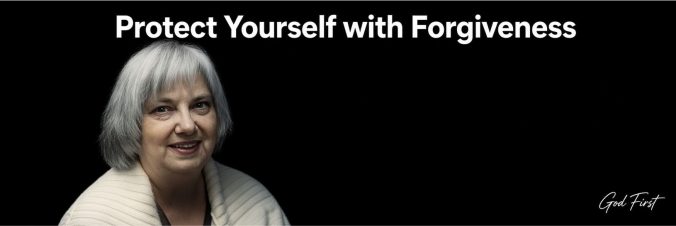
Protect Yourself with Forgiveness

One of the most memorable pieces of advice my mom ever gave me was, “Don’t go to bed mad,” and Mom lived by her words. Mom was the sweetest, most forgiving person I’ve ever known.

I saw Mom’s feelings hurt many times over the years (by all of us.) Of course, those things happen within families from time to time, but to the best of my knowledge, Mom never burdened herself with grudges. She might go to bed in tears or with some sadness occasionally, but never with bitterness, anger, or the desire for revenge toward others.

If you hurt Mom’s feelings and apologized, she accepted it with joy so that the wounds could heal quickly. On the other hand, if you never apologized, I think Mom just turned it over to God because she knew grudges harm our souls. I wish everone could have known my mom; she was awesome, and we miss her!

Jesus thought it necessary for us not to hold grudges against each other; in fact, in Jesus’s own words, He said: “But I say to you that everyone who is angry with his brother shall be guilty before the court; and whoever says to his brother, ‘You good-for-nothing,’ shall be guilty before the supreme court; and whoever says, ‘You fool,’ shall be guilty enough to go into the fiery hell. Therefore if you are presenting your offering at the altar, and there remember that your brother has something against you, leave your offering there before the altar and go; first be reconciled to your brother, and then come and present your offering.” Matthew 5:22-24

So, If you have harmed someone, make it right; if you’ve been hurt, do your best to make it right, and don’t let the sun go down on your anger.

“If possible, so far as it depends on you, live peaceably with all.” Romans 12:18

Be forgiving!

see: Ephesians 4:26–27; Matthew 5:22–24; Romans 12:18; Ephesians 4:30–32; Colossians 3:13; Matthew 6:14–15.

God First!

Do you ever ask yourself why?

  • Why did I respond this way?
  • Why did I do that?  
  • Why did I say that?
  • Why did I get mad at them? It was my fault.

Many years ago, while in my mid-twenties, I rented a house. After being there for close to a year, I fell behind on my rent. The landlord, Mr. Blackwell, a very nice man whom I liked very much, sent me my first pay-or-get-out eviction letter. For some reason, rather than understanding that this letter was necessary and that it was my fault, I got embarrassed, upset, and angry with him, and moved out. During my anger, I retaliated by leaving the water running in every sink and at every outside spigot. My intent was not to destroy but to cost him money in wasted water.  

I was the one in the wrong, yet for some reason, I retaliated against the innocent, as we see many do today.

I got upset when I was told to pay or leave. I would later talk with Mr. Blackwell, who asked me, why did you leave the water running everywhere? I had no answer other than to apologize for my misplaced anger. I have remembered this bad decision many times over the years as I disrespected this good man with anger that should have been directed only at myself.

I certainly remembered this story when, many years later, as a landlord myself, a tenant fell far behind and skipped out, leaving our house in shambles and smelling of animal urine. I spent my recovery from a hip replacement tearing out carpet, removing and replacing pee-soaked subflooring, etc., so we could sell the house. I kept telling myself as I worked each day of those two months, I had this coming, although Virginia did not deserve the stress.  

Unfortunately, it seems this type of misdirected anger is all around us every day, where self-accountability and common sense are discarded, and those in the wrong become angry at those doing the right things.  When we can’t pay our rent or mortgage, it’s not our landlords’ fault. If we break a law and are held accountable, it’s not the fault of the police or our justice system.

In my scripture-based opinion, each person is responsible for their actions. I would much rather be held accountable here on earth than for eternity. I know that forgiveness for all things is possible if we will pick up the cross and follow Jesus by keeping His commandments, and that God is capable of mercy and of forgetting our sins. Still, I don’t believe Scripture teaches that forgiveness releases anyone from accountability.  

Matthew 6:12, Proverbs 28:13, Romans 8:1-3, Romans 14:12, 2 Corinthians 5:10, Matthew 12:36, Luke 12:48, Isaiah 43:25, Hebrews 5:12, Jeremiah 31:34

God First!

© 2026 Advocate for Christ

Theme by Anders Noren — Up ↑