The best life is a God First life

Tag: Scripture

God’s Word & Mike the Baker

Mike is your new friend who happens to be a baker. You tell him you love carrot cake and have the perfect recipe. Mike learns your birthday is coming up and offers to bake your cake, so you give him the recipe. Across the top in large letters you write: “IMPORTANT! Follow the recipe as written. Don’t add or leave anything out.”

The recipe specifies the ingredients, the order they are mixed, and even the brands to use. You stress the importance of following the directions, and Mike agrees.

At the store, Mike decides some specified ingredients are not the best, so he chooses what he believes is better. At home he mixes the ingredients according to your directions—almost. The directions call for them to be mixed in a specific order, but that doesn’t fit Mike’s ideas and would take longer. He also adds one extra ingredient he thinks will improve it. Then he invites your family over.

Mike is pleased, grinning ear to ear, confident you will love it. The cake looks fantastic, and everyone digs in. It is dry, bland, and not what you expected. Suddenly you notice nuts. Your daughter gasps for air. You call 911.

Sound familiar?

You had knowledge Mike did not, yet you gave him precise instructions and stressed: “DON’T ADD OR TAKE AWAY FROM THIS RECIPE.” You had specific reasons.

  • Were you pleased with Mike’s efforts?
  • Mike used his free will and did things his way, even after agreeing to follow your instructions. Was that the right decision?
  • By changing and adding to your recipe, Mike ruined the afternoon and endangered your loved one. His intentions were good—does that matter?
  • Should Mike blame you for not giving more information? Or should he be sorrowful and humble for failing to follow the recipe as he agreed?

God has specific reasons for every word in Scripture. He has knowledge we do not have and has emphasized that we follow His Word according to His Word (Revelation 22:18-19). God knows what is best for us. He cares. He wants everyone to receive the benefit of the ultimate sacrifice made for all mankind.

In God’s recipe for salvation He gives examples and commandments for how to live best. He tells us how to “put on Christ,” be “in Christ,” and be heaven-bound. Christ both shows and tells us how to demonstrate love for God.

Shouldn’t we strive to follow God’s recipe as He wrote it? His will, not ours, be done (Luke 22:42).

Unlike Mike doing his own will, doing God’s will gives a true reason to grin ear to ear. It brings absolute joy and the promise of eternal life.

“If you love Me, you will keep My commandments” (John 14:15).

Salvation is by God’s grace through the blood of Christ—the free gift we could never earn. The steps below are the means He has given for a person to receive that grace, not works that merit it.

Grace (the foundation—salvation is the gift of God)
Ephesians 2:8-9, Romans 3:24, Titus 2:11, Acts 15:11, Titus 3:4-7

Hearing the Gospel
Romans 10:17, John 8:32

Belief/Faith
Hebrews 11:1, John 8:24, Romans 10:17

Repentance of sin
2 Corinthians 7:9-10, Luke 13:3-5, Acts 17:30, Acts 3:19

Confess Christ
Romans 10:9-10, Matthew 10:32-33, Luke 12:8-9

Baptism by immersion for the forgiveness of sins
(the point at which the penitent believer is buried with Christ, contacts His blood, has sins washed away, and puts on Christ—not a work of human merit)
1 Peter 3:21, Acts 2:38, Mark 16:16, John 3:5, Matthew 28:18-20, Ephesians 4:5, Romans 6:3-4, Colossians 2:12, Acts 8:36-39, Mark 1:9-10, John 3:23, Acts 22:16, Galatians 3:27

Additional supporting passages
Deuteronomy 4:2; 12:32 (do not add to or take from God’s word); Colossians 2:11-12; Titus 3:5

God’s recipe for salvation is clear and complete. It begins with His grace and the blood of Christ. He has told us exactly how to receive that grace: hear the gospel, believe, repent, confess Jesus as the Christ, and be baptized into Christ for the forgiveness of sins. Just as changing the ingredients or the method ruined the cake and endangered life, changing or omitting any part of God’s instructions leaves us outside of Christ. When we follow His Word exactly as He wrote it, we have every reason to rejoice—we are in Christ, our sins are forgiven, and eternal life is the promise. His will, not ours, be done.

God First!

Even in Death, Stephen Was Teaching

As Christians, we should strive to follow Stephen’s example by teaching God’s Word from the beginning to the end of this worldly life.

Even in death, Stephen was teaching!

“Then they cast him out of the city and stoned him. And the witnesses laid down their garments at the feet of a young man named Saul. And as they were stoning Stephen, he called out, ‘Lord Jesus, receive my spirit.’ And falling to his knees he cried out with a loud voice, ‘Lord, do not hold this sin against them.’ And when he had said this, he fell asleep.” (Acts 7:58–60)

Note verse 59: “And as they were stoning Stephen, he called out, ‘Lord Jesus, receive my spirit.’”

Here, Stephen’s words exemplify what faith, trust, and commitment entail. He did not keep these words only in his heart; he loudly called them out. Stephen did not beg them to stop or try to take back his words. Instead, he demonstrated his belief in and trust in God by his example. With a loud voice, Stephen teaches them and us as he identifies their action as sin.

Saul (later Paul) was present for all of this (verse 58). Whether the men stoning Stephen recognized it in the moment or only later, their actions were not justice but sin. Among his last words, Stephen called them out on this. Certainly this did not escape Paul as he later grew in understanding.

In his death, Stephen also teaches forgiveness. In verse 60, he asks God not to hold this sin against them. This teaches us that Stephen did not leave this world with a grudge or hating those who were taking his life. Rather, he left demonstrating compassion for their ignorance and love for the souls of his murderers, appealing to God for their forgiveness of this sin.

It is reasonable to imagine how Paul may have reflected on these memories later in life. How they may have burned in his heart, knowing he could not change what he had been part of, yet these memories likely became fuel that drove him to teach and share Jesus no matter what the worldly consequences might be.

Paul later stated: “The saying is trustworthy and deserving of full acceptance, that Christ Jesus came into the world to save sinners, of whom I am the foremost. But I received mercy for this reason, that in me, as the foremost, Jesus Christ might display His perfect patience as an example to those who were to believe in Him for eternal life. To the King of the ages, immortal, invisible, the only God, be honor and glory forever and ever. Amen.” (1 Timothy 1:15–17)

Stephen teaches us that the message does not stop when life is threatened. We are called to speak the truth and extend forgiveness even when it costs us. May we follow his example by teaching God’s Word from the beginning to the end of this worldly life.

For reference: Acts 7:58–60; 1 Timothy 1:15–17; Colossians 3:13; 1 John 2:15–17; Hebrews 13:14–16; Matthew 6:21; Mark 16:15; Luke 23:34, 46; Acts 8:1; Philippians 1:21; Romans 12:14, 21; 2 Timothy 4:7–8.

God First!

Choices make a difference

Deuteronomy 30:15–20

15 “See, I have set before you today life and prosperity, and death and adversity;
16 in that I command you today to love the Lord your God, to walk in His ways and to keep His commandments and His statutes and His judgments, that you may live and multiply, and that the Lord your God may bless you in the land where you are entering to possess it.
17 But if your heart turns away and you will not obey, but are drawn away and worship other gods and serve them,
18 I declare to you today that you shall surely perish. You will not prolong your days in the land where you are crossing the Jordan to enter and possess it.
19 I call heaven and earth to witness against you today, that I have set before you life and death, the blessing and the curse. So choose life in order that you may live, you and your descendants,
20 by loving the Lord your God, by obeying His voice, and by holding fast to Him; for this is your life and the length of your days, that you may live in the land which the Lord swore to your fathers, to Abraham, Isaac, and Jacob, to give them.”

Joshua 24:14–15

14 “Now, therefore, fear the Lord and serve Him in sincerity and truth; and put away the gods which your fathers served beyond the River and in Egypt, and serve the Lord.
15 If it is disagreeable in your sight to serve the Lord, choose for yourselves today whom you will serve: whether the gods which your fathers served which were beyond the River, or the gods of the Amorites in whose land you are living; but as for me and my house, we will serve the Lord.”

Matthew 7:13–14

13 “Enter through the narrow gate; for the gate is wide and the way is broad that leads to destruction, and there are many who enter through it.
14 For the gate is small and the way is narrow that leads to life, and there are few who find it.”

John 3:16–18

16 “For God so loved the world, that He gave His only begotten Son, that whoever believes in Him shall not perish, but have eternal life.
17 For God did not send the Son into the world to judge the world, but that the world might be saved through Him.
18 He who believes in Him is not judged; he who does not believe has been judged already, because he has not believed in the name of the only begotten Son of God.”

Related passages (NASB1995)

  • Romans 10:9–10: “that if you confess with your mouth Jesus as Lord, and believe in your heart that God raised Him from the dead, you will be saved; for with the heart a person believes, resulting in righteousness, and with the mouth he confesses, resulting in salvation.”
  • Hebrews 2:3: “how will we escape if we neglect so great a salvation? After it was at the first spoken through the Lord, it was confirmed to us by those who heard,”
  • Hebrews 3:12–15: “Take care, brethren, that there not be in any one of you an evil, unbelieving heart that falls away from the living God. But encourage one another day after day, as long as it is still called ‘Today,’ so that none of you will be hardened by the deceitfulness of sin. For we have become partakers of Christ, if we hold fast the beginning of our assurance firm until the end, while it is said, ‘Today if you hear His voice, Do not harden your hearts, as when they provoked Me.’”
  • 2 Thessalonians 1:7–9: “and to give relief to you who are afflicted and to us as well when the Lord Jesus will be revealed from heaven with His mighty angels in flaming fire, dealing out retribution to those who do not know God and to those who do not obey the gospel of our Lord Jesus. These will pay the penalty of eternal destruction, away from the presence of the Lord and from the glory of His power,”

Thank You—And Why I Keep Writing

Thank you to everyone who reads the messages in Advocate for Christ. Writing and sharing these posts is one way I can do good and serve the Lord while caring for a loved one with Alzheimer’s (see Galatians 6:9). I don’t write for accolades. If something here encourages or challenges you, feel free to respond with a like, love, comment, or share—especially if you believe it could benefit someone else. That’s how these messages get seen and read on social media.

My hope is twofold:

  1. To strengthen, encourage, and inspire those who are in Christ to study, grow, and practically apply God’s Word to daily life. As iron sharpens iron, so one person sharpens another (Proverbs 27:17). I welcome respectful, Scripture-based conversation that helps us all grow.
  2. To share the message of Christ with those who do not yet know Him—those who are currently lost according to God’s Word. By turning from their own way (repentance) and trusting and obeying Jesus, they can receive forgiveness and the promise of eternal life. This change of life and doing His will flows from trusting Him. His yoke is easy and His burden is light (Matthew 11:28–30).

My intent is not that anyone believe my words simply because I said them, but that they spark further study. If what I wrote differs from what you believe, please clarify the difference with Scripture—not feelings. Our souls depend on it, and I want to know if I am wrong so I can correct it. How about you?

Today, much so-called wisdom is grounded in feelings that weaken, discount, or set aside truth. This artificial wisdom encourages apathy when following Scripture conflicts with someone’s preferences or ideas. God is unchanging, and His Word is unchanging.

The truth is in God’s Word, not in what any man or woman teaches.

John 17:17; Proverbs 26:12; Proverbs 27:17; 2 Timothy 2:15; 1 John 4:1; Hebrews 4:12; Galatians 6:9; Matthew 11:28–30

God First!

HIS PURPOSE STANDS

We are incredibly blessed to have the Bible!

When we study God’s Word, we find that those involved often know only what is right in front of them, but as readers we get to see God’s plans come together again and again.

We have 66 books of God-breathed evidence to help us understand that putting our faith, hope, and trust in God is the best commitment we can make and share with our friends and loved ones.

The evidence that God is in control abounds. His purpose does not change, and He works all things according to the counsel of His will. That same Word shows that by trusting and obeying the gospel of the New Covenant—hearing the word of Christ, dying to sin, and being raised to walk in newness of life—we can have eternal life in heaven.

This world is not our forever home.

2 Timothy 3:16–17 (God-breathed Scripture)
2 Timothy 2:15 (handle the word accurately)
Romans 10:17 (faith comes by hearing)
Hebrews 6:17 (God’s purpose is unchangeable)
Ephesians 1:11 (God works all things according to His will)
Matthew 6:33 (seek first the kingdom of God)
Romans 6:1–4 (baptized into Christ’s death and raised to new life)
Hebrews 13:14 (we seek the city that is to come)

Romans 10:9–10; Hebrews 6:17–19; Ephesians 1:7–11; Matthew 6:19–21; Romans 6:1–4; Hebrews 8:6–13; Hebrews 9:15; Hebrews 11:13–16; Genesis 50:20; Isaiah 46:9–10; Psalm 33:11; Acts 2:38; Mark 16:16; Acts 22:16; 1 Peter 3:21; Colossians 2:12; Philippians 3:20–21; John 14:1–3; 2 Peter 1:20–21; 1 Timothy 5:18; 2 Peter 3:16

God First!

The Truth Is Right Before Us

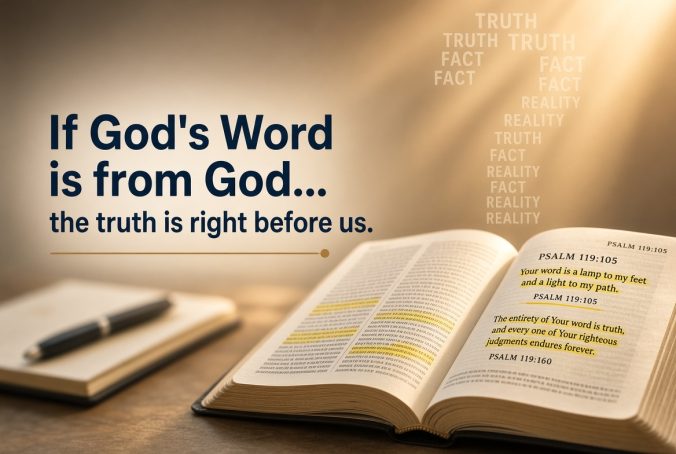
When I compose writings for spiritual consideration, it’s not about what I feel but what God’s Word says. Is that not what we should want to follow? That’s what I try to convey in my efforts, and it’s why I repeatedly encourage self-study. If we truly believe “God’s Word is God’s Word,” the truth is right before us. If we refuse to believe what God has spoken, we treat Him as a liar (see 1 John 5:10; 1 John 1:10)

All Scripture is inspired by God and profitable… ( see 2 Timothy 3:16-17).

Often, I list scriptures as references in my writings, hoping the reader will review them and maybe even go a step further by reading and studying the context of the verses.

I strongly encourage study and dialogue; I don’t have all the answers, but I’m willing to help find them.

Do you have questions? Let’s study!

2 Timothy 3:16-17; Acts 17:11; 1 John 5:10; 2 Peter 1:20-21; John 17:17; Psalm 119:160; Hebrews 4:12; Matthew 4:4; 1 Thessalonians 2:13; Psalm 119:105; Isaiah 40:8; John 10:35; 1 Corinthians 2:13.

God First!

Understanding God’s Word

There are many misrepresentations of God’s word in the world today, and yes, scripture needs to be studied to be interpreted properly, not just read. If any scripture seems to contradict itself at any point, we are misinterpreting it and should study it more deeply to identify what we are missing.

Who it was written to, when it was written, and for what purpose can help us gain more insight than what we might get from scripture’s face value alone.  Sort of like the milk vs. solid-food scripture.

God, through His infinite wisdom and in His Word, has given us what we need for our understanding so that we can know what we must do to be saved. The whole Bible is from God, and no matter our educational level, if we have access to God’s word, we have access to God’s intent for us, without needing to know the background and history of every word we read.

Today, there are many translations of Scripture, written in multiple languages, some created with little scrutiny and sometimes with an agenda rather than strict interpretation. In contrast, others, such as the KJV, were completed using “rules of language” with strict interpretation and incredible scrutiny. Most later versions use the KJV as their base.

I have complete trust in God and don’t believe God would allow the translations from the languages of old to be included in the King James Bible if they did not convey His Words and intent properly, so I believe the correct interpretations from those old languages have been preserved. We don’t need to be Greek Scholars to understand God’s intent.

“Every word of God is flawless; He is a shield to those who take refuge in Him.”

Proverbs 30:5

Consider 2 Timothy 2:15 KJV: “Study to shew thyself approved unto God, a workman that needeth not to be ashamed, rightly dividing the word of truth.”

While understanding the meat behind this scripture, such as who the letter was written to, Timothy’s history, and all the interesting additional information one can derive with deep study to gain deeper insight, the milk of this passage of Scripture stands on its own, pointing out that we need to study, to show ourselves, workmen, not ashamed, rightly dividing the word of truth.

God’s Word is the whole of Scripture. God only needs to say something once for it to be true. That said, to understand what God says once correctly, one may also need to know more of Scripture; however, some attempt to change the face-value meaning of Scripture by using other possible Greek interpretations to claim the interpretation of all those past Scholars is wrong, in order to convey a message that tickles their ears and, sadly, misleads others.

As stated in Scripture, God did not give us a book of confusion, and no prophecy of Scripture comes from someone’s own interpretation and provides understanding even to the simple. We all gain at different levels, but we all gain by studying scripture.

  • 2 Peter 1:20
  • 1 Corinthians 14:33
  • Psalm 119:30
  • 2 Timothy 3:16
  • 1 Corinthians 3:21
  • 1 Peter 2:2
  • Hebrews 5:12-13

God First!

How often must God say something for it to be True?

From the beginning of creation, God’s Word has been Truth and nothing but Truth, and it will continue to be so to the end of time as we know it. God is Unchanging, God is Love, God is Good, God does not Lie! When someone discounts the importance of Scripture or flat-out dismisses it, they dismiss God, effectively deciding they know better than God. According to God’s Word, all of scripture is God-breathed. In other words, all of Scripture is inspired by God, giving us what God wants us to know and follow (see 2 Timothy 3:16-17)

If someone says they don’t believe “ALL” scripture is from God, or that it really means something other than what is stated, are they not calling God a liar or implying God goofed? If scripture tells you something is wrong one time, yet society, someone, or a culture tells you it’s ok or meant differently than what you can read, who’s right? — My answer is God!

When Scripture is pointed out, many respond: “Well, that’s your interpretation.” However, scripture tells us: “knowing this first of all, that no prophecy of Scripture comes from someone’s own interpretation.” (2 Peter 1:20) In other words, Scripture is from God.

In 1 Corinthians 14:33, scripture states: “For God is not a God of confusion but of peace, as in all the churches of the saints.”

Some try to reinterpret the Greek to force an interpretation that yields their desired result; however, in this effort, the problem is not with God’s Word.  No, the problem is with the individual seeking an answer different from what’s in God’s Word. God’s Word is true, as written for our understanding, not our confusion.

We don’t need to be Greek scholars to understand God’s face value meaning. So, if one believes in God and that the Bible is God’s Word, they should also understand that Scripture has only one correct answer, the one that God intended, and that answer will not contradict any other scriptures.

“The unfolding of the words gives light; it imparts understanding to the simple” Psalms 119:30

“I warn everyone who hears the words of the prophecy of this book: if anyone adds to them, God will add to him the plagues described in this book, 19 and if anyone takes away from the words of the book of this prophecy, God will take away his share in the tree of life and in the holy city, which are described in this book.” Revelation 22:18-19

  • Hebrews 6:17-18
  • Titus 1:1-2
  • 1st John 4:16
  • Psalm 136:1

God First!

Inspiration

Not every moment is as upbeat as I want it to be. Sometimes, sadness and reflection can bring us down. When this happens, holding these verses in our hearts and minds can help lift our spirits.

I hope sharing them here will help lift yours as well.

“I know what it is to be in need, and I know what it is to have plenty. I have learned the secret of being content in any and every situation, whether well fed or hungry, whether living in plenty or in want, I can do all this through Him who gives me strength.” Philippians 4:12-13

“Paul, an apostle of Christ Jesus by the will of God, and Timothy our brother, To the church of God that is at Corinth, with all the saints who are in the whole of Achaia: Grace to you and peace from God our Father and the Lord Jesus Christ. Blessed be the God and Father of our Lord Jesus Christ, the Father of mercies and God of all comfort, who comforts us in all our affliction, so that we may be able to comfort those who are in any affliction, with the comfort with which we ourselves are comforted by God. For as we share abundantly in Christ’s sufferings, so through Christ we share abundantly in comfort too.” 2nd Corinthians 1:3-5

“What has been is what will be, and what has been done is what will be done, and there is nothing new under the sun.” ‭‭Ecclesiastes‬ ‭1‬:‭9‬ ‭ESV‬‬‬‬‬‬‬

“Submit yourselves therefore to God. Resist the devil, and he will flee from you. Draw near to God, and He will draw near to you. Cleanse your hands, you sinners, and purify your hearts, you double-minded.” ‭‭James‬ ‭4‬:‭7‬-‭8‬ ‭ESV‬‬‬‬‬‬‬‬

“Therefore do not be anxious, saying, ‘What shall we eat?’ or ‘What shall we drink?’ or ‘What shall we wear?’ For the Gentiles seek after all these things, and your heavenly Father knows that you need them all. But seek first the kingdom of God and His righteousness, and all these things will be added to you. “Therefore do not be anxious about tomorrow, for tomorrow will be anxious for itself. Sufficient for the day is its own trouble.” Matthew‬ ‭6:31-34‬ ‭ESV‬‬‬‬

“Let what you heard from the beginning abide in you. If what you heard from the beginning abides in you, then you too will abide in the Son and in the Father. And this is the promise that He made to us—eternal life.” ‭‭1 John‬ ‭2‬:‭24‬-‭25‬ ‭ESV‬‬‬‬‬‬‬‬

“And let us not grow weary of doing good, for in due season we will reap, if we do not give up. So then, as we have opportunity, let us do good to everyone, and especially to those who are of the household of faith.” ‭‭Galatians‬ ‭6‬:‭9‬-‭10‬ ESV‬‬‬‬‬

God is Love!

God First!

Bible Translations

The languages of the Bible are unique to their time, and this is excellent!

Here is why

Language scholars can refer to the original writings to clarify meaning. They can discover how the original text was used and written. Often, the words in the original language have several possible meanings. Yet only one of those meanings fits best within the context of how the word was used and stays consistent with the whole of other scripture.

None of the manuscripts or letters are in the original writer’s hand. They were all copied by scribes repeatedly, regardless of the type of paper or stone they were originally written on.

With the “King James Version,” all the manuscripts available at the time were combined into the books of the Bible. The translations were completed by a large group of approximately 50 highly qualified scholars. These scholars checked, double-checked, and triple-checked the letters and manuscripts they had. They tested each piece against a set of rules they created to ensure it had been correctly translated. These scholars also defined the chapters, verses, and punctuation to facilitate reading today, as these were not part of the original language.

More transcripts were found after the “King James” translation. Some of these writings were older than those used to create the KJV. Many modern versions use the King James Version as their base to create versions that are easier for readers to understand. In contrast, other versions compare the manuscripts used to translate the KJV with older manuscripts and then revise the new versions, prioritizing the older manuscripts. Note: In a few cases, an entire verse was removed based on older writings; these changes were minor and did not alter the text of Scripture.

If English is our native tongue, we often think only of these versions as being in Old or modern English; however, many translations of God’s Word have been made in multiple languages.

It’s also true that not all versions were translated with the same care. In fact, some versions are no more than one person’s interpretation, while others are produced by groups with an agenda beyond a strict translation; this is why it’s essential to understand how a translation came about to determine how much credibility we should accord to what we read.

Personally, I like ESV, KJV, NKJ, NASB1995, and the ASV the most. I also use other versions occasionally to help understand some verses. The most meticulous interpretation of scripture undertaken in the 1600s, under the threat of death, was the KJV.

As a follower of Christ and not a scholar of biblical languages, I rely heavily on versions I believe were compiled with the greatest accuracy.

All this said, I trust God

I believe God’s Holy Word is just that: God’s Holy Word. I trust each word and believe it is possible to understand everything God wants us to understand clearly. We just need to set aside our desires and expectations, open our hearts and minds, and pay attention to God’s desires and will.

The Bible is not a book of confusion.

What makes it seem confusing is us. When we try to twist what it says into what we think it should say. We also need to remember that the Bible is a collection of several books that make one book. So, when we look at one verse using the word faith, it does not discount all the verses that include baptism and vice versa.

What’s the whole picture? What do the books combined tell us is necessary for Salvation?

If we’re willing to admit to ourselves that we may have more to learn. The complete answer is available to us in Scripture

The Bible continues to be the #1 bestseller

I cannot fathom God giving us His complete Word in forms we can’t possibly understand. Can you?

I can’t perceive that God went through all this effort, including the sacrifice of Christ on the Cross so that we might have eternal life, spent thousands of years bringing all of this to fruition, only to give us a Bible, we can’t trust to be accurate or understand with a little effort, reasoning, and discernment; this would be ridiculous.

“All Scripture is breathed out by God and profitable for teaching, for reproof, for correction, and for training in righteousness, that the man of God may be complete, equipped for every good work.”

2 Timothy 3:16-17 ESV

God First!

© 2026 Advocate for Christ

Theme by Anders Noren — Up ↑