The best life is a God First life

Category: Bible Study (Page 2 of 2)

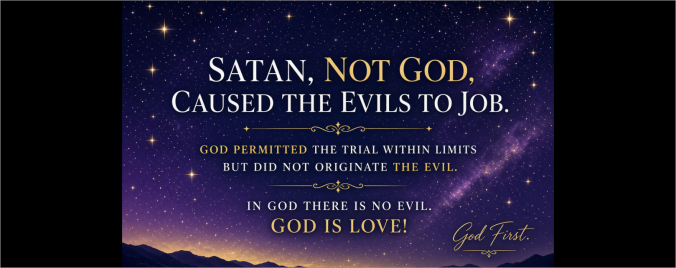
Satan, Not God: Caused the Evils Against Job

Satan, NOT God, caused the great wind that killed the family of Job.
Satan, NOT God, did all the evils to Job.
Satan, NOT God, is behind all the evil we see in today’s world.
In God, there is no evil; although God may test us, God will never test us with evil or beyond what we can bear.
When we choose to rely on God and be servants of God’s love rather than slaves to sin, God is our strength and refuge.

Scripture shows that Satan was the direct agent who carried out these evils against Job (Job 1:12–19; 2:7). God permitted the trial within strict limits but did not originate the evil. Later statements in Job that speak of the adversity the Lord “brought” are the common biblical idiom for permission, not the claim that God is the source of moral evil. In every case, God remains free of evil and does not tempt anyone with it. God remains pure, upright, and free of all moral evil.

God is love!

James 1:13-15; Job 1:12-19; Job 2:7; 1 John 4:8, 16; John 14:30; 1 John 5:19; 2 Corinthians 4:4; Psalm 92:15; 1 Corinthians 10:13; Psalm 46:1; Romans 6:12-23; John 8:32, 34-36

God First!

If Jericho Fell on the News: Would We Alter the Gospel?

While listening to Joshua’s account of the fall of Jericho in the Old Testament, I wondered how it would be received in today’s world of Social media and live news feeds. I imagine the media would explode with interviews, conjecture, ridicule, and laughter run-amok. Would there be even one media source that would not be mocking these followers of God who say their God is the “One and Only God” in my opinion, the sarcasm would be relentless.

Can you envision the video they would capture or the reporter’s words? “These people actually believe the huge city walls in this video will collapse if they march around the city once a day for six days while staying quiet, and then on day seven march around the city seven times with priest blowing trumpets; then, at the sound of one last trumpet, they believe all they have to do is yell, and this massive wall, this huge massive wall of Jericho, is going to fall down so they can take the city”

Can you imagine the news coverage? How about the jaw-dropping shock to the world of unbelievers when the wall falls?

Do you think the walls of Jericho would have fallen if they had done anything less than what God commanded them to do? The same God who specified the march also specified how a person comes into Christ. Hebrews 11:30 says the walls fell by faith after they had been encircled for seven days. The city had already been given (Joshua 6:2); the marching did not earn it. The promise was attached to the instructions, and the result came when those instructions were kept

For some reason, many today take huge liberties with God’s word and make statements along the lines of, “God loves us; Jesus died for us, and because He loves us, we don’t need to be baptized (immersed) to be saved. We don’t need to gain understanding, repent, confess Jesus as Lord, or change our life; all we have to do is say a prayer, and we are saved, and once we are saved, we are always saved.

Scripture does not present a prayer as the converting act. It names belief, repentance, confession, and baptism for the forgiveness of sins (Mark 16:16; Acts 2:38; 22:16; Romans 10:9–10). A changed life follows that response; it is not a work done beforehand to earn it (Romans 6:4; John 14:15). Passages on security address those who continue in Christ (John 10:28–29; Romans 8:38–39). They do not cancel the warnings against falling away we find in (Hebrews 3:12–14; 10:26–29; 2 Peter 2:20–22).

What if a priest in Joshua’s camp said, 7 times is unnecessary; God loves us; let’s pray, then blow the trumpets and yell, ‘God is with us! Or any other variance from God’s command. Do you really believe the walls would have fallen had anything less than God’s command been done?

I don’t!

God attached the promise to the instructions He gave. The walls fell when those instructions were kept (Joshua 6:20). I do not believe a substituted plan would have brought the same result.

The walls would never have fallen if they had done anything other than what God told them to do. In 2 Kings 5:14, Naaman was told to dip seven times in the River Jordan to heal his leprosy; He first wanted a different method. He was cleansed when he dipped seven times “according to the saying of the man of God. ”had he tried to sprinkle water on his body or do anything else, he would not have been healed because he did not do as God commanded. We are told to teach the message of Christ with boldness and love, not by changing the message to get more people to listen or respond. Doing so is foolish!

Christ’s blood is the ground of forgiveness. Faith, repentance, confession, and baptism are the conditions God set for receiving it—not works that earn it.

Throughout Scripture, we have words and examples showing that it is important to do God’s will, God’s way, as stated in His Holy Word, not our own desires. This was true then, and it’s true now.

Jesus tells us, “If you love Me, you will keep My Commandments.” God specified the way at Jericho. He has specified the way now.

Hebrews 11:30; Joshua 6:2–5, 20; 2 Kings 5:10–14; Mark 16:16; Acts 2:38; 22:16; Romans 6:3–4; Galatians 3:26–27; 1 Peter 3:21; John 14:15; Matthew 7:21; James 2:14–26; Hebrews 5:9.

God First!
Millions Estimated Lost—Eight Were Saved

Scholars estimate that millions were living on Earth at the time of the great flood. Noah, a preacher of righteousness, spent decades building an Ark on dry land and, while building it, also preached righteousness before the impending flood. Many probably thought Noah was nuts, at least until the day the rain fell. The day reality set in, the day it was too late to act. (Sound familiar)

Today, science, archaeology, history, and Scripture provide overwhelming evidence that Jesus lived, died, and was raised again. Today, God-breathed, inspired Scripture shows us how, through belief and obedient faith, we can repent, confess Christ, and be Immersed “In Christ,” buried in the waters of baptism for the forgiveness of our sins. Scripture tells us of Christ’s return, His judgment, and how, by God’s grace and our obedient faith, we can look forward to receiving new glorified bodies, living forever with Christ in heaven and forever with our brothers and sisters “in Christ.”

Unfortunately, just like with the rejection of Noah, the message of Christ is constantly being rejected or skewed. Those sharing the truth of His message are often ridiculed and dismissed as religious fanatics for attempting to share the news of Christ with the hope that people will react and respond.

Christ is the most important message you will ever hear. Please don’t wait until it’s too late to act.

Do a self-check, do a biblical check, and be certain the path you’re on is the path God set before us all in His Holy Word, not a rendition of truth crafted by those who tickle ears. (see: 2 Timothy 4:3–4)

Accepting God’s love includes accountability.

  • Romans 14:12
  • 2 Peter 2:5
  • Hebrews 11:7
  • Genesis 6:5–22
  • 1 Peter 3:20–21
  • Romans 10:17
  • Mark 16:16
  • Acts 2:38
  • Romans 10:9–10
  • 2 Timothy 2:15
  • 2 Timothy 4:3–4
  • Philippians 3:20–21
  • Romans 6:3–8
  • see also: Genesis 7:1, 5, 16, 21–23; Genesis 9:19; Matthew 24:36–44; Luke 17:26–27; John 3:5; Acts 2:36–41; Acts 22:16; 1 Corinthians 15:51–53; Ephesians 2:8–10; Colossians 2:12; 2 Timothy 3:16–17; 2 Peter 3:3–13; 1 John 1:7           

God First!

God’s Greatest Commandments: Love Him First, Love Others Always

Jesus answered, “The most important is, ‘Hear, O Israel: The Lord our God, the Lord is one. And you shall love the Lord your God with all your heart and with all your soul and with all your mind and with all your strength.’ The second is this: ‘You shall love your neighbor as yourself.’ There is no other commandment greater than these.” And the scribe said to him, “You are right, Teacher. You have truly said that he is one, and there is no other besides him. And to love him with all the heart and with all the understanding and with all the strength, and to love one’s neighbor as oneself, is much more than all whole burnt offerings and sacrifices.” Mark 12:29-33

Matthew records the same teaching this way: “On these two commandments depend all the Law and the Prophets” (Matthew 22:40). They do not erase the rest of God’s will. They show what every command is for: wholehearted love for God, and real love for people.

  • Love God with all your heart, soul, mind, and strength.
  • Love your neighbor as yourself.

“Love your neighbor as yourself” assumes we already seek our own good; it does not teach self-worship but we cannot claim love for God while refusing to love others as ourselves. These are not mutually exclusive (1 John 4:20–21)

Jesus calls us to follow Him daily. He knows what is best for us. Luke 9:23 says that following Him means denying ourselves and taking up the cross daily. Are we drawing closer to Him in prayer and study? Or are we so occupied with everything else that we rarely think of our Savior, or even take time to pray?

Jesus does not treat love as a warm feeling we can have while ignoring what He said. “If you love me, you will keep my commandments” (John 14:15). He also gave a new command: love one another as He loved us—not only as we love ourselves (John 13:34; John 15:12–13).

That’s A LOT OF LOVE!

“Draw near to God, and He will draw near to you. Cleanse your hands, you sinners; and purify your hearts, you double-minded.” James 4:8

In the above verse, James calls double-minded people to repent. Drawing near means turning from a split loyalty—not merely adding a brief prayer to a crowded day.

In Christ we can have the peace of God, which surpasses understanding, as we bring our requests to Him with thanksgiving (Philippians 4:6–7). Prayer, however, is not a substitute for the Word. God’s Word cannot teach us if we leave it closed. “Do your best to present yourself to God as one approved… rightly handling the word of truth” (2 Timothy 2:15).

  • 2 Timothy 2:15
  • John 13:34
  • John 14:15
  • Mark 12:29-33
  • Matthew 22:40
  • Philippians 4:6–7
  • 1 John 4:20–21
  • James 4:8
  • Deuteronomy 6:4-5; Leviticus 19:18; John 15:12-13; Romans 13:8-10; Galatians 5:14; 1 John 4:7-11, 19-21; Luke 9:23; Philippians 4:6-7;

God First!

Do We Really Believe God? Then Who Will Humbly Reason from His Word?

We have no shortage of knowledge at our fingertips, yet we have a vast shortage of open minds. Minds willing to humble themselves as they discuss and reason about God’s Word. Instead of being offended when something contradicts our current beliefs, why not turn to Scripture and let God’s complete words be the final answer?

“For we know in part and we prophesy in part, but when completeness comes, what is in part disappears.” (1 Corinthians 13:9-10 NIV)

Are you offended or curious when someone states something from God’s Word that you’ve been taught differently? Is it possible you have been taught only part of the answer? Do you take time to review the Scripture they provide to support their claim, or do you go to a preacher or friend for a response? Will you take time to examine the Scriptures daily to see whether their points are true, or will you cling to your feelings on the matter?

Why not let the inspired words of God do the talking so you can learn more fully? Why not study the whole truth more closely yourself and seek answers from God’s word to any discrepancies between what you believe and what God’s word tells us?

This is how we can unite with Scripture! Instead of forcing pieces of Scripture to fit our feelings and current understanding, take a closer look.

This is the example the Apostle Paul gave us; he went into the synagogues to reason.

While in Thessalonica, Paul “reasoned with them from the Scriptures, explaining and proving that it was necessary for Christ to suffer and to rise from the dead, and saying, ‘This Jesus whom I proclaim to you is the Christ.” And some of them were persuaded…” Acts 17:2-6

Paul reasoned from Scripture, yet not all were persuaded.

Later, in the town of Berea, Paul went into the synagogue to reason, and God’s word points out that those in this synagogue: “Now these Jews were more noble than those of Thessalonica; They received the word with all eagerness, examining the Scriptures daily to see if these things were so.” Acts 17:11

Why were they considered more noble? Because of their open minds and eagerness to know the truth

By approaching God’s word with an open mind, we will indeed do our best to learn. So, let’s do so eagerly, examining Scripture to see if what we understand is so.

2nd Timothy 2:15 tells us: “Do your best to present yourself to God as one approved, a worker who has no need to be ashamed, rightly handling the word of truth.”

1 Corinthians 14:33 tells us: ”For God is not a God of confusion but of peace. As in all the churches of the saints,”

“Humble yourselves before the Lord, and He will lift you up.” (James 4:10 NIV)

“I appeal to you, brothers and sisters, in the name of our Lord Jesus Christ, that all of you agree with one another in what you say and that there be no divisions among you, but that you be perfectly united in mind and thought.” (1 Corinthians 1:10 NIV“)

Isaiah 1:18; Psalm 119:18, 119:105, 119:160; Proverbs 2:1-6; Proverbs 3:5-6; Proverbs 18:13; John 17:17; Acts 17:2-4; Acts 17:11; Romans 15:4; 1 Corinthians 1:10; 1 Corinthians 13:9-10; 1 Corinthians 14:33; Galatians 1:8-9; Ephesians 4:3-6, 4:13-15; 1 Thessalonians 5:21; 2 Timothy 2:15; 2 Timothy 3:16-17; James 1:21-25; James 4:6, 4:10; 2 Peter 1:19-21; 1 John 4:1.

God’s word is complete.

God First!

Joy Is Not the Absence of Pain

The Bible tells us to  “in everything give thanks; for this is God’s will for you in Christ Jesus” (1 Thessalonians 5:18)

To count it all joy (James 1:2-4)

Joy is not the absence of suffering and pain we all experience in this life, but knowing that this life is but a temporary home.

By doing God’s will and keeping Jesus’s commandments, we lay up treasure in Heaven for ourselves, giving those in Christ complete confidence that Heaven is our Forever Home. It does not teach salvation by works; rather, it describes the life of those already “in Christ.” (see Matthew 6:19–20, John 14:15) This gives us a peace beyond understanding which belongs to those who remain in Christ.

May we always be thankful and count it all joy. “Sanctify Christ as Lord in your hearts, always being ready to make a defense to everyone who asks you to give an account for the hope that is in you, yet with gentleness and reverence” (1 Peter 3:15).

  • Revelation 3:8-11, .Romans 8:18; Romans 8:28; John 16:33; Hebrews 13:14; 2 Corinthians 5:1; 1 Peter 1:3–7; Colossians 3:1–4; Philippians 4:4–7; Hebrews 11:13–16; 2 Corinthians 4:16–18; Revelation 21:3–4; Matthew 6:19–21; John 14:1–3, 15; Galatians 6:9; 1 Peter 3:15.

God First!

Help Others See What They Can Become in Christ

I am very thankful for all the encouragement I’ve received, both directly and indirectly, over the years. I’m thankful for those whose examples made me long to be more like them, as they lived lives that glorified Christ. It was obvious in their actions and words, in their concern for others, and in how and where they spent their time. Their efforts exemplified Christ’s life and personified selflessness.

These examples of good people made me want to examine myself, study God’s word, and deepen my understanding. These few people who affected me so much are now many in my life—many because I now choose to surround myself with them and others like them. In my opinion, their encouragement and edification have helped me become a better person.

I miss seeing many of these people weekly, as we did before Alzheimer’s affected our lives in such a way that we couldn’t. However, I still follow many of these outstanding examples on social media.

The people I speak of here are part of the Lord’s Church and helped me realize the importance of biblical study and of becoming and living as a Christian—because it doesn’t happen through osmosis! NO, these people continuously challenged me to study God’s Word together and independently, and now I strive to help others “see what they can become” in Christ, and through Christ, so we can all become better Me’s.

“Help others see what they can become” ~Philip Sanders

1 Thessalonians 5:11; Hebrews 10:24-25; Ephesians 4:29; Philippians 2:4; 2 Timothy 2:15, Proverbs 27:17; Matthew 5:16; 1 Corinthians 11:1; Philippians 3:17; Hebrews 3:13; 2 Corinthians 3:18; Ephesians 4:15-16; Romans 15:14; Colossians 3:16; 1 Timothy 4:12; Titus 2:7; 1 Peter 2:12.

God First!

HIS PURPOSE STANDS

We are incredibly blessed to have the Bible!

When we study God’s Word, we find that those involved often know only what is right in front of them, but as readers we get to see God’s plans come together again and again.

We have 66 books of God-breathed evidence to help us understand that putting our faith, hope, and trust in God is the best commitment we can make and share with our friends and loved ones.

The evidence that God is in control abounds. His purpose does not change, and He works all things according to the counsel of His will. That same Word shows that by trusting and obeying the gospel of the New Covenant—hearing the word of Christ, dying to sin, and being raised to walk in newness of life—we can have eternal life in heaven.

This world is not our forever home.

2 Timothy 3:16–17 (God-breathed Scripture)
2 Timothy 2:15 (handle the word accurately)
Romans 10:17 (faith comes by hearing)
Hebrews 6:17 (God’s purpose is unchangeable)
Ephesians 1:11 (God works all things according to His will)
Matthew 6:33 (seek first the kingdom of God)
Romans 6:1–4 (baptized into Christ’s death and raised to new life)
Hebrews 13:14 (we seek the city that is to come)

Romans 10:9–10; Hebrews 6:17–19; Ephesians 1:7–11; Matthew 6:19–21; Romans 6:1–4; Hebrews 8:6–13; Hebrews 9:15; Hebrews 11:13–16; Genesis 50:20; Isaiah 46:9–10; Psalm 33:11; Acts 2:38; Mark 16:16; Acts 22:16; 1 Peter 3:21; Colossians 2:12; Philippians 3:20–21; John 14:1–3; 2 Peter 1:20–21; 1 Timothy 5:18; 2 Peter 3:16

God First!

God’s purpose could be you

Although God is never mentioned by name in the Book of Esther, we find a powerful example of how God works through people to accomplish His purposes. Unbeknownst to most involved at the time, it becomes very evident how several things came together to achieve God’s purposes.

In this story, Esther had to make a major decision: not to be silent. She simply had to do what was right, which would require her to risk her life. Mordecai pointed out that if Esther chose silence, the Jews’ deliverance would still come, but from another source.

“For if you keep silent at this time, relief and deliverance will rise for the Jews from another place, but you and your father’s house will perish. And who knows whether you have not come to the kingdom for such a time as this?” Esther 4:14 ESV

Through God’s Providence, we see evil and evil intent converted into justice for God’s people using Esther and Mordecai. (Read Esther; it’s an interesting story)

Who knows today how God is working through our lives to accomplish His purposes? In my mind, as long as we are pursuing good and willing to stand for righteousness, speak up for Christ, and show our love for Him by keeping His commands, we offer ourselves as servants—vessels to be used for God’s good purposes even when we never know it. We just can’t be afraid to take a stand and speak up!

God is Great, God is good, God is love – ALL THE TIME.

Esther 4:14; Esther 4:16; Romans 8:28; Genesis 50:20; Proverbs 16:9; Ephesians 2:10; Acts 17:27; John 14:15; Philippians 2:13; Isaiah 46:10; Psalm 37:23; 1 Peter 3:15; Matthew 5:16

God First!

Newer posts »

© 2026 Advocate for Christ

Theme by Anders Noren — Up ↑